Singapore Research Pilot: Service Innovation Scorecard
The service innovation capability scorecard has been designed to give you a detailed understanding of your company’s innovation capability and to highlight specific improvement opportunities
Singapore Research Pilot: Service Innovation Scorecard
The service innovation capability scorecard has been designed to give you a detailed understanding of your company’s innovation capability and to highlight specific improvement opportunities
Case Studies in Service Innovation Workshop (CSSI’12)
26th June 2012
http://www.ssmenetuk.org/netactivity.asp
Submission Deadline: 11th March 2012
In conjunction with 24th International Conference on Advanced Information Systems Engineering (CAiSE’12), Gdańsk, Poland http://www.caise2012.univ.gda.pl/
The workshop is organised by
Centre for Service Research, University of Manchester, UK
Informatics Research Centre, Henley Business School, UK
UK Chapter, Service Research and Innovation Institute (www.thesrii.org)
The aim of the workshop is to bring together contributions from researchers and practitioners to better understand service innovation through real life case studies. The workshop seeks to address the underlying theories, models, and tools that contribute to innovation, how it works in practice and how its impact is evaluated. The workshop will add to the wider understanding of how service innovation occurs and will seek to stimulate learning from one context to another.
In this workshop we are calling for real-life case studies of Service Innovation. Experience has shown that innovation may be driven by new architectures or information services but real business benefit is often not fully achieved without accompanying process innovation, organisational change or wider innovation management. The workshop will address the complexity of service innovation and hence contribute to a key objective of the CAiSE 2012 conference, that is, to illustrate the need for new transdisciplinary ways of thinking.
Case studies in Service Innovation can include but are not limited to the following areas:
KEY DATES
Submission of the case for review March 11, 2012
Notification of acceptance April 6, 2012
Final submission April 30, 2012
Workshop June 26, 2012
SUBMISSION GUIDELINES
Papers should be submitted in PDF format via EasyChair https://www.easychair.org/conferences/?conf=cssi12. Submissions must conform to Springer’s LNCS format (see http://www.springer.com/computer/lncs?SGWID=0-164-6-791344-0) and should not exceed six (6) pages, including all text, figures and references.
Submissions should provide a description of the context in which the innovation occurred, the opportunity that led to the innovation and an overview of the innovation itself. It should also address how success was measured, what success has been achieved to date and links to further information and related references. The suggested contents of each submission are as follows:
The workshop will be organised around five major themes each reflecting recognised sources of service innovation (see http://www.ssmenetuk.org/“>www.ssmenetuk.org). The five themes are:
Theme 1: Business Model Innovation: Service innovation through new ways of creating, delivering or capturing value (economic, social, environmental or other types of value).
Theme 2: The Organisation in its Environment: Service innovation through an organisation engaging beyond its own boundaries, for example through public private partnerships; sourcing knowledge externally; innovation networks; open or distributed innovation.
Theme 3: Innovation Management within an Organisation: Service innovation through an organisation actively encouraging innovation within its own boundaries, for example through project teams, internal governance of innovation, methods or tools that stimulate innovation.
Theme 4: Process Innovation: Service innovation through changes in service design and delivery processes, for example through consumer-led innovation or consumers as part of the innovation process, service operations management, educational processes.
Theme 5: Technology Innovation: Service innovation through the use of technology, for example through ICT-enabled innovation, ICTs that are themselves innovative and support the delivery of new services, new ICT services, new ways of delivering services associated with ICT products, technology other than ICT.
Accepted cases will be included in the proceedings published by the workshop organisers and will be available at the SSMEnetUK website. The best and extended workshop papers will be published in a special issue of the http://www.igi-global.com/journal/international-journal-information-system-modeling/1157/” target=”_blank”>International Journal of Information System Modeling and Design; In addition, selected and extended papers will also be published in Service Science: Research and Innovations in the Service Economy http://www.springer.com/series/8080“>http://www.springer.com/series/8080 book series.
WORKSHOP ORGANISERS
Babis Theodoulidis (mailto:b.theodoulidis@manchester.ac.uk“>b.theodoulidis@manchester.ac.uk)
Centre for Service Research, Manchester Business School, University of Manchester, UK
Linda Macaulay (mailto:lindamacaulay2@btinternet.com“>lindamacaulay2@btinternet.com)
Centre for Service Research, Manchester Business School, University of Manchester, UK
Yin Leng Tan (mailto:y.l.tan@henley.reading.ac.uk“>y.l.tan@henley.reading.ac.uk)
Informatics Research Centre, Henley Business School, University of Reading, UK
PROGRAMME COMMITTEE
Youakim Badr, INSA Lyon, France
Pere Botella, Universita Polytecnica de Catalunya, Spain
Hansjoerg Fromm, Karlruhe Institute of Technology, Germany
Kazuyoshi Hidaka, Tokyo Institute of Technology, Japan
Pedro Hidalgo, University of Chile, Chile
Michael Lyons, BT Innovate & Design, UK
Kecheng Liu, Henley Business School, UK
Vaughan Michell, Henley Business School, UK
Ian Miles, Manchester Business School, UK
Hamid Motahari-Nezhad, Hewlett-Packard, USA
Steve Street, IBM Global Technology Services, UK
Marja Toivonen, VTT Technical Research Centre, Finland
Jennifer Wilby, Hull University Business School, UK
Hossein Seif Zadeh, Royal Melbourne Institute of Technology, Australia
Liping Zhao, University of Manchester, UK
—
Dr Yin Leng Tan
Lecturer in Business Informatics
Business Informatics, Systems and Accounting | Henley Business School | University of Reading
Whiteknights, Reading RG6 6UD, UK
t: +44(0)118 378 4032
Transitioning from a Goods-Dominant to
a Service-Dominant Logic: Visualising the
Value Proposition of Rolls-Royce
_____________________________________________________________________
Irene Ng
Glenn Parry
Laura Smith
Roger Maull
Gerard Briscoe
To remain viable, manufacturers have bundled equipment sales with support
services. This provision has been commonly referred to as the servitization of
manufacturing (Neely, 2008), a stream of research often dealt with through
manufacturing literature.
http://wrap.warwick.ac.uk/42144/1/WRAP_Ng_wmg-220212-transitioning-wp5.pdf
Dear Colleagues and Scientists,
Considering your research in related areas, we cordially invite you to submit a paper to AMCIS 2012 (Seattle)- Mini-Track: Service Mining: Technology, Management and Application (http://amcis2012.aisnet.org/index.php/program/tracks-and-minitracks/103-sigebiz-smtma).
The goal of this mini-track is to attract different disciplines such as artificial intelligence, management, operations management, and statistics to focus on mining “services” in the new paradigm. Due to the significant revenue of service industry around the world, service mining is worth to investigate to help companies earn more profit from now on.
Note: Full paper and Research-in-Progress paper are acceptable
Deadlines
Submission: March 1, 2012
Author Notification: April 6, 2012
Camera Ready: April 25, 2012
Dear Colleagues
As you may know, this year the Cornell School of Hotel Administration is celebrating its 90th year of service to the hospitality industry. In addition, our school’s Center for Hospitality Research (CHR), which is a the leading source for quality research on and for the hospitality industry, is also celebrating its 20th year.
In our effort to honor the long-term active collaboration with the industry, CHR, on behalf of the School, is organizing the second Cornell Hospitality Research Summit during October 8-9th 2012 at our Ithaca campus. This event will bring together approximately 300 industry leaders and academic scholars so that they can participate in live, interesting and engaging conversation related to contemporary issues facing the industry.
The conference will begin with a CEO panel that Dean Johnson will moderate. Following the keynote session, the conference will feature a series of presentation and workshop sessions related to the conference theme (Service Excellence and Performance Growth in the Global Hospitality Industry: Strategies and Approaches for Navigating Forward). Both academic scholars and industry executives are invited to present during the conference.
The Call for Submissions which was announced last month. Submission deadline is March 2nd.
I encourage you and your colleagues to submit a proposal for consideration for presentation during this research summit. Additional information about the submissions process and conference is attached below.
Best Regards,
Rohit
Rohit Verma, Ph.D.
Chair, CHRS 2012
Professor & Executive Director, Center for Hospitality Research
Cornell University School of Hotel Administration
Office: +1-607-255-2688
Email: rohit.verma@cornell.edu
Web: www.chr.cornell.edu
Note that the submission deadline has been extended to March 16, 2012.
============== SERVICE COMPUTATION 2012 | Call for Papers ===============
CALL FOR PAPERS, TUTORIALS, PANELS
SERVICE COMPUTATION 2012, The Fourth International Conferences on Advanced Service Computing
July 22-27, 2012 – Nice, France
General page: http://www.iaria.org/conferences2012/SERVICECOMPUTATION12.html
Call for Papers: http://www.iaria.org/conferences2012/CfPSERVICECOMPUTATION12.html
– regular papers
– short papers (work in progress)
– posters
Submission page: http://www.iaria.org/conferences2012/SubmitSERVICECOMPUTATION12.html
Submission deadline: March 16, 2012
Sponsored by IARIA, www.iaria.org
Extended versions of selected papers will be published in IARIA Journals: http://www.iariajournals.org
Please note the Poster and Work in Progress options.
The topics suggested by the conference can be discussed in term of concepts, state of the art, research, standards, implementations, running experiments, applications, and industrial case studies. Authors are invited to submit complete unpublished papers, which are not under review in any other conference or journal in the following, but not limited to, topic areas.
All tracks are open to both research and industry contributions, in terms of Regular papers, Posters, Work in progress, Technical/marketing/business presentations, Demos, Tutorials, and Panels.
Before submission, please check and conform with the Editorial rules: http://www.iaria.org/editorialrules.html
SERVICE COMPUTATION 2012 Topics (topics and submission details: see CfP on the site)
Service innovation, evaluation and delivery
Service requirement validation; Service design; Service deployment; Service delivery; Service lifecycle; Service knowledge and service innovation; Model-driven service engineering; Knowledge-intensive services; Risk management in services management; Service testing and validation; Service consumption and delivery outcome; Quality of service; Quality of experience; Quality of service impact; Service audit metrics; Service innovation; Service bundling; Service research; Service composition; Collaborative services; Service business models; Service personalization; Security and trust in services
Ubiquitous and pervasive services
Foundations of ubiquitous and pervasive services, networks and applications; Specification, discovery, and matching of ubiquitous and pervasive services; Computing, orchestration and harmonization of ubiquitous and pervasive services; Technologies for modeling, designing, and testing ubiquitous and pervasive services; Service-oriented agent-based architectures, protocols and deployment environments; Integration and deployment of ubiquitous and pervasive services; Ubiquitous and pervasive services in peer-to-peer and overlay networks; Ubiquitous and pervasive services in mobile networks and sensor networks; Ubiquitous and pervasive services in unmanned air, underwater, and ground vehicle networks; Adaptive and self-adaptive ubiquitous and pervasive services; Context awareness, adaptation and management of ubiquitous and pervasive services; Security, trust and privacy management in ubiquitous and pervasive services; Semantics and ontology for ubiquitous and pervasive servi!
ces; Web services and middleware support for ubiquitous and pervasive services; Energy management and harvesting for network with ubiquitous and pervasive systems; Case studies, lessons learned, experiments, simulations and trials for ubiquitous and pervasive services
WEB Services
Basics and formalisms on Web services; Web x.0 concepts in Web services evolution in this framework; Methodologies for specification, deployment and enhancements of Web services; Modeling and composition of Web services; Discovery, matching, and integration of Web services; SLA/QoS/QoE in Web services (privacy, security, performance, reliability, fault tolerance); Testing and validating Web services; Publishing, discovery, tracking, and selection of Web services; Web services lifecycle management; Semantics and Ontology in Web services; Cloud computing, service-as-a-software and on-demand Web services; Mobile and intermittent Web services; Web services-based services, applications and solutions; Web services standards and formalizations; Service-Oriented Architecture (SOA) infrastructure and middleware
Society and business services
Public (mail, schools, banking, financial, personal, real estate, health, government, insurance, hospitals, transportation, library); Utility (broadcasting & cable TV, printing & publishing, energy, Internet, hotels, retail, waste management, security, rental); Entertainment (advertising, casinos & gaming, recreational, restaurant, travel); Business (communications, specialty, technology, planning, supply chain management, marketing, design, wholesale distribution); Business process management (business knowledge, business protocols, service level agreements, business licensing models, business financial models, and business advertizing models
Committee: http://www.iaria.org/conferences2012/ComSERVICECOMPUTATION12.html
====================
Note that the submission deadline has been extended to March 16, 2012.
============== COGNITIVE 2012 | Call for Papers ===============
CALL FOR PAPERS, TUTORIALS, PANELS
COGNITIVE 2012, The Fourth International Conference on Advanced Cognitive Technologies and Applications
July 22-27, 2012 – Nice, France
General page: http://www.iaria.org/conferences2012/COGNITIVE12.html
Call for Papers: http://www.iaria.org/conferences2012/CfPCOGNITIVE12.html
– regular papers
– short papers (work in progress)
– posters
Submission page: http://www.iaria.org/conferences2012/SubmitCOGNITIVE12.html
Submission deadline: March 16, 2012
Sponsored by IARIA, www.iaria.org
Extended versions of selected papers will be published in IARIA Journals: http://www.iariajournals.org
Please note the Poster and Work in Progress options.
The topics suggested by the conference can be discussed in term of concepts, state of the art, research, standards, implementations, running experiments, applications, and industrial case studies. Authors are invited to submit complete unpublished papers, which are not under review in any other conference or journal in the following, but not limited to, topic areas.
All tracks are open to both research and industry contributions, in terms of Regular papers, Posters, Work in progress, Technical/marketing/business presentations, Demos, Tutorials, and Panels.
Before submission, please check and conform with the Editorial rules: http://www.iaria.org/editorialrules.html
COGNITIVE 2012 Topics (topics and submission details: see CfP on the site)
BRAIN: Brain information processing and informatics
Cognitive and computation models; Human reasoning mechanisms; Modeling brain information processing mechanisms; Brain learning mechanisms; Human cognitive functions and their relationships; Modeling human multi-perception mechanisms and visual, auditory, and tactile information processing; Neural structures and neurobiological process; Cognitive architectures; Brain information storage, collection, and processing; Formal conceptual models of human brain data; Knowledge representation and discovery in neuroimaging; Brain-computer interface; Cognition-inspired complex systems
COGNITION: Artificial intelligence and cognition
Expert systems, knowledge representation and reasoning; Reasoning techniques, constraint satisfaction and machine learning; Logic programming, fuzzy logic, neural networks, and uncertainty; State space search, ontologies and data mining; Games, planning and scheduling; Natural languages processing and advanced user interfaces; Cognitive, reactive and proactive systems; Ambient intelligence, perception and vision
AGENTS: Agent-based adaptive systems
Agent frameworks and development platforms; Agent models and architectures; Agent communication languages and protocols; Cooperation, coordination, and conversational agents; Group decision making and distributed problem solving; Mobile, cognitive and autonomous agents; Task planning and execution in multi-agent systems; Security, trust, reputation, privacy and safety in agent-based systems; Negotiation brokering and matchmaking in agent-oriented protocols; Web-oriented agents (mining, semantic discovery, navigation, etc.; SOA and software agents; Economic agent models and social adoption
AUTONOMY: Autonomous systems and autonomy-oriented computing
Self-organized intelligence nature-inspired thinking paradigms; Swarm intelligence and emergent behavior; Autonomy-oriented modeling and computation; Coordination, cooperation and collective group behavior; Agent-based complex systems modeling and development; Complex behavior aggregation and self-organization; Agent-based knowledge discovery and sharing; Autonomous and distributed knowledge systems; Autonomous knowledge via information agents; Ontology-based agent services; Knowledge evolution control and information filtering agents; Natural and social law discovery in multi-agent systems; Distributed problem solving in complex and dynamic environments; Auction, mediation, pricing, and agent-based market-places; Autonomous auctions and negotiations
APPLICATIONS
Agent-oriented modeling and methodologies; Agent-based interaction protocols and cognitive architectures; Emotional modeling and quality of experience techniques; Agent-based assistants and e-health; Agent-based interfaces; Knowledge and data intensive classification systems; Agent-based fault-tolerance systems; Learning and self-adaptation via multi-agent systems; Task-based and task-oriented agent-based systems; Agent-based virtual enterprise; Embodied agents and agent-based systems applications; Agent-based perceptive animated interfaces; Agent-based social simulation; Socially planning; E-Technology agent-based ubiquitous services and systems
Committee: http://www.iaria.org/conferences2012/ComCOGNITIVE12.html
====================
Extension of Deadline of submitting ICWS 2012 Research Track Papers to: 2/29/2012 (Notification date: 3/30/2012)
::::::::::::::::::::::::: CALL FOR PAPERS :::::::::::::::::::::::::
The 19th IEEE International Conference on Web Services (ICWS 2012)
June 24-29, 2012, Hyatt Regency Resort and Spa, Honolulu, Hawaii, USA
Conference rate: $175/night with Internet access included
Theme: Data-Centric Web-based Services
Celebrating the Merger between ICWS & ECOWS in 2012!
http://conferences.computer.org/icws/2012/
Sponsored by: IEEE Computer Society Technical Committee on Services Computing (http://tab.computer.org/tcsc)
*************************************** JOURNAL PUBLICATIONS **********************
Best Paper and Best Student Paper will be automatically invited to turn in extended versions to be published by the IEEE Transactions
on Services Computing (TSC). Top papers will be invited to submit extended versions to TSC, International Journal of Web Services Research
(JWSR), and International Journal of Business Process Integration and Management (IJBPIM). Both TSC and JWSR are SCI and EI indexed.
—————————————————————-
***For any queries, please send emails to icws.ieeecs@gmail.com. ***
SSMEnetUK Service Innovation Case Studies
We need more of these Service Innovation Case Books, like the one created for this 2010 conference…
Diagram: 
URL: http://www.ssmenetuk.org/docs/ServiceInnovation_CaseBook_pre_conference.pdf
Historic Document: Services Science
An IBM Global Team Issue Paper v.1.0
ISSUE
While manufacturing continues to play a vital role in the US economy, it is the service sector that dominates in the production of economic output and employment. Services include everything from professional service workers (medical, financial, consulting, IT) to food service employees, to transportation providers, fitness trainers and manicurists. An increased proportion of the manufacturing activity is linked to services due to outsourcing of information processing functions, supply chain integration, customer support and administrative functions. The common trait is that the product is not tangible—instead it is a service that is performed.
BACKGROUND
Given the prevailing role of services in advanced economies and the mounting global footprint of service activities, a greater research priority should be given to understanding how innovation works in the service sector and how it contributes to national competitiveness and economic growth. Service businesses also need to know more about methodologies for transforming business processes and the necessary integration of processes, technologies, and the people managing and acting upon them. Manufacturing represents just 17% of the US economy, yet we’re devoting nearly two-thirds of our research to it. Over 71% of our economy is represented by services, but we are investing only a 37% of our research investment to it. A better alignment is in order. To know more about this complex subject a new discipline in the services sciences is needed to develop the intellectual basis for solving problems in business process design, organizational transformation, workforce training, integration of services with manufacturing and developing technologies that have the potential to spur entirely new economic growth paths.
Diagram: 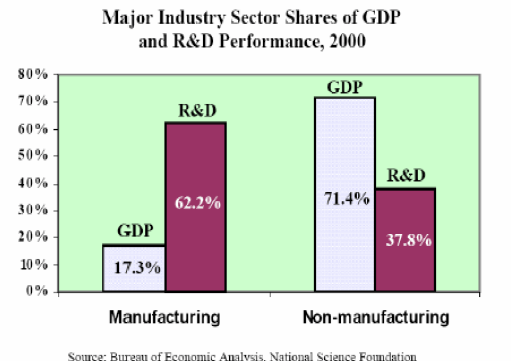
IBM POSITION
1. Encourage government R&D funding agencies to address the problems involved in transforming business services and what is required to develop improved innovation models, business methods, innovation performance metrics and the necessary research/technology roadmaps. The effort should be global in scope, multidisciplinary and scientifically rigorous.
2. Support creation of a new academic discipline that combines and is taught in schools of business, engineering and computer science. The approach will require that scientists and business practice and planning intersect.
IBM Leaders: Ginni Rometty, General Manager, BCS
Paul Horn, Senior Vice President, Research
This was originally posted in 2004 (as of 1/1/2012 Ginni Rometty is IBM’s CEO)
URL: http://www.ibm.com/ibm/governmentalprograms/pdf/Issue_Paper_Services_Science_v.1.0.pdf
This was a IBM-hosted Faculty Summit event outcome document from the same time