Professional Science Masters Conference (Denver, Nov 7-9)

Enhancing Global Workforce Competitiveness through PSMs
NPSMA 3rd National Conference and Members’ Meeting
Denver, Colorado
November 7-9, 2012
http://www.npsma.org/upcoming-national-conferences

Creating T-shaped professionals with depth in science and breadth across business, law, and policy.  Very good background for service innovation.

The Professional Science Master’s (PSM) degree is a two-year graduate degree designed to fill a management need for technology-based companies, governmental agencies, and non-profit organizations. Professional Science Master’s programs combine rigorous study in science or mathematics with coursework in management, policy, or law.

Overview of the NPSMA and the PSM Degree

The National Professional Science Master’s Association (NPSMA) is a collaborative of Professional Science Master’s (PSM) degree program directors, faculty, administrators, industry representatives, alumni, and students that supports PSM degree initiatives. It engages businesses, industries, nonprofit organizations, governmental agencies, and trade associations in the development of PSM degree programs and internship and job placement opportunities for PSM students and graduates.

The NPSMA serves as the focal point for the collective interaction of the nation’s PSM degree programs with organizations that have a stake in graduate education in science, mathematics, and technology. The NPSMA initiates and encourages these exchanges by holding workshops and conferences, publishing research findings on PSM degree developments, sharing PSM policy developments, and, most importantly, connecting the various constituents of the PSM.     Click Here to see Overview Presentation.

The Professional Science Master’s (PSM) degree is a two-year graduate degree designed to fill a management need for technology-based companies, governmental agencies, and non-profit organizations. Students pursue advanced training in science, while simultaneously developing valued business skills. Professional Science Master’s programs combine rigorous study in science or mathematics with coursework in management, policy, or law. Professional Science Master’s programs emphasize writing and communication skills, and many include project management.  Most PSM programs require a final project or team experience, as well as an internship in a business or public sector enterprise.

Developed in concert with industry, PSM programs are designed to dovetail into present and future professional career opportunities. Graduates are equipped to manage the breakthroughs that are created by the research teams. They can interact comfortably and intelligently with scientific researchers and business managers, especially in the marketing, finance, and legal departments.  Courses such as policy or regulation are often included in programs designed for those interested in working in governmental agencies.

The Professional Science Master’s (PSM) degrees serve the needs of scientists who want to improve their skills in business. The PSM program is designed to fill a management need for technology-based companies, governmental agencies, and non-profit organizations. The business training is complemented by advanced science training in pertinent fields depending on the degree science/engineering focus.  The U.S. is on the verge of losing its lead as an innovative and technological leader in the world, because it is not generating an adequate highly-trained workforce. PSM degrees are part of the solution!

For More Information:
http://www.npsma.org/

Guide to the Systems Engineering Body of Knowledge (SEBoK)

The current version of the Systems Engineering Body of Knowledge (SEBoK) is intended for broad world-wide use, adds to the rapidly maturing discipline of systems engineering.  It consists of 7 parts broken into 26 knowledge areas, with 112 topics.  There are 5 use cases, 7 case studies, and 6 vignettes to illustrate the contents.  The glossary has 363 entries, and there are 224 primary references plus hundreds more additional references.

The operational phase for the SEBoK is beginning, with anticipated minor updates twice a year, and a possible major update every third year.

Shared stewardship of the SEBoK between INCOSE, IEEE-CS, and the SERC, is expected soon.

About Systems Engineering

Systems engineering is an interdisciplinary approach and means to enable the realization of successful systems. Separate articles in Part 1 provide an overview of systems engineering, place it in historical context, and discuss its economic value.

Systems engineering has roots in systems science. Major sections (called knowledge areas (KAs)) in Part 2 discuss Systems Fundamentals, Systems Thinking, Representing Systems with Models, and the Systems Approach Applied to Engineered Systems.

About the SEBoK

The SEBoK is organized into 7 parts, with a Glossary of Terms and a list of Primary References.

The other parts are:

As a compendium, much of the contents has restricted intellectual property rights. This copyright information is placed on each page, and must be respected. The current SEBoK copyright is held by the Trustees of the Stevens Institute of Technology, and plans for the transfer of the copyright are discussed in SEBoK Evolution.

As a living document, each page footer also contains version identification in a link called “About SEBoK 1.0.”

A PDF version may be downloaded at Download SEBoK PDF.

There is a link in the left margin under Toolbox explaining how to Cite the SEBoK correctly.


For More Information:
http://www.sebokwiki.org/1.0/index.php/Main_Page

Warwick University: Service Management and Design (Masters Degree)

Service Management and Design (SMD)

For Leaders and Managers in Service-Based Industries

Designed for

Service is at the heart of a new business paradigm that assumes co-creation of value across a network of suppliers. Many businesses have been driven to reinvent themselves to meet global challenges as they change their business model for commercial advantage. This transition requires strong leadership that blends multidisciplinary expertise.

This MSc course is suitable for you if you want to work as a leader or manager in service based industries. You will learn the systems and techniques used to manage service industries and creation of value in the business across suppliers within the industry and within industry processes.

Learning Outcomes

Through a combination of both practice and academic rigour you will develop the skills and knowledge to be able to:

  • Throughly understand customer needs, be able to manage business performance through the development of personal awareness/capabilities for managing services.
  • Understand the importance of experience and value to all stakeholders and be able to create a stakeholder map and use it to inform service design or redesign.
  • Develop awareness of excellence in service from a variety of sectors from across the globe.
  • Understand the lifecycle of service systems and have a working knowledge of tools, techniques and trends for service design and management.
  • Understanding the principles of selling services and the implications on structuring a service organisation.
  • Gain the theoretical knowledge to understand and explain the emergent behaviour of systems and recognise the importance of data, process control and measures to drive the right behaviour.
  • Appreciate costing techniques and the implications of networks of value and lifecycle cost models to make the right decisions.
  • Have awareness of information systems and enabling technologies for service.

Lean Six Sigma Green Belt Accreditation

Enrolment on the MSc Service Management and Design gives you the opportunity to take the “Lean Six Sigma Green Belt” course in addition to your Masters programme. This additional professional qualification aligns with the MSc project, the work undertaken for the Green Belt qualification can form the basis of the case for your dissertation.

For more information:
http://www2.warwick.ac.uk/fac/sci/wmg/education/wmgmasters/courses/smd/

Rough Estimate of Service Science Related Graduates

Each year, about 100,000 students graduate worldwide with standard degrees  (business, engineering, etc.) that include some elements of  service science related course materials.   This number is probably increasing by about 1,000 to 2,000 university graduates per year.  About 9-10 million people worldwide graduate with college degrees every year…   So about 1% of college graduates have some service science exposure, and this is growing by about 1-2% per year…

The growth is proportional to the size of the knowledge-intensive service sector in nations….

Globally service sector jobs are 40% of all jobs, and 50% of those are knowledge-intensive, so 20% of jobs world-wide are knowledge-intensive service sector jobs… to first approximation, think of knowledge-intensive jobs in banking,  finance, health, education, government, legal, business professionals, science-technology-engineering professionals, etc.  — all industry and societal sectors have executive, management, and technical-specialists who can be considered part of knowledge-intensive service workers – knowledge workers, for short.

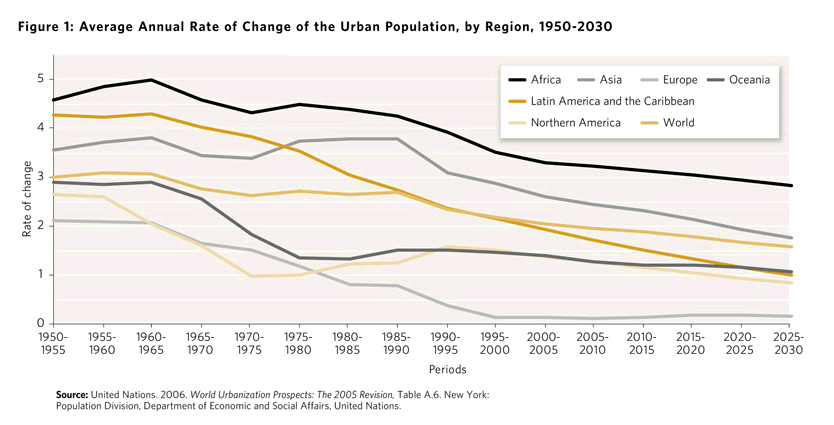
These grow annually as a result of automation and urbanization.  For example,  (1) smarter machines and robotic processes continue to transform agriculture and manufacturing, and low-end service jobs (automation), and (2)  villagers move to the cities around the world (urbanization)

The numbers increase every year, but the growth rate declines – because a larger percentage of the worlds population lives in cities doing service sector jobs…

(for example, in Europe almost everyone already lives in Cities, and North America will be next…)


So about 20% of all jobs worldwide are knowledge intensive service jobs, and this percentage is increasing by about 1-2% per year…

Of these knowledge-intensive service jobs, many need some post-secondary education, and many need college degrees.

The college degrees whether engineering or business degrees require some level of exposure to service science related concepts….

Service engineering, service computing, service marketing, service management,  service operations, service design, etc.

So while we do not know how many students are graduating with service science degrees, we estimate that over 100,000 students are graduating each year with standard degrees that have some element of service science in them…. these students get jobs as computer scientists, industrial engineers, marketing, operations, etc. – which is there major degree… service science is being infused in their curriculum.

The world has ~3 billions workers…
http://www.nationmaster.com/graph/lab_for_tot-labor-force-total

Currently 6.7% of the world population holds a college degree, and that is increasing
http://www.huffingtonpost.com/2010/05/19/percent-of-world-with-col_n_581807.html

Worldwide about 18 millions students enroll in colleage each year (2007)
http://howtoedu.org/college-facts/how-many-people-go-to-college-every-year/

Graduate rates around the world are about 40-50%
http://globalpublicsquare.blogs.cnn.com/2011/11/03/how-u-s-graduation-rates-compare-with-the-rest-of-the-world/

Of course, these are very rough estimates, and it would be a good service science PhD student project to improve our understanding of this…


Seven new articles in Service Science – check ’em out!

Service Science, Fall 2012: 4(3)

1. Ching-I Teng, Shao-Kang Lo, and Yi-Jhen Li
How Can Achievement Induce Loyalty? A Combination of the Goal-Setting Theory and Flow Theory Perspectives

Abstract: The motivation theory has identified achievement as a critical factor for online game play. However, how achievement induces gamer loyalty (the intention to play a certain game continuously) has not been explored. This study thus used the goal-setting theory to identify two achievement-related motivators: achievement striving (desire for achievements) and competence (confidence at obtaining achievements). Moreover, flow theory was used to develop hypotheses on how achievement striving and competence induce gamer loyalty. Based on the responses from 994 online gamers, our results indicate that achievement striving and competence among gamers are positively related to skill and perceived challenge. Additionally, skill and perceived challenge are positively related to flow, and flow is positively related to gamer loyalty. We recommend that game providers target individuals who are high in achievement striving and competence, or increase gamer desire for those motivators at obtaining achievements, in order to construct a loyal gamer base.

2. Robert M. Saltzman
Planning for an Aging Fleet of Shuttle Vehicles with Simulation

Abstract: San Francisco State University operates a small but aging fleet of shuttle vehicles that facilitate travel by its affiliates to, from, and around campus. Its shuttle system is primarily intended to supplement municipal bus service in connecting the university to the nearest Bay Area Rapid Transit train station in Daly City, California, approximately a mile and a half south of campus. This article presents an animated discrete-event simulation model of the system that can be used by campus planners to make capital improvement decisions about the fleet. In particular, the model can help identify the best type of shuttle (in terms of capacity and number of doors) to replace the older existing vehicles. Furthermore, experimentation with the model can predict how different fleet configurations would accommodate various increases in ridership; e.g., if ridership increases 40% over the next few years, a satisfactory level of service can be maintained by replacing just two of the fleet’s six existing shuttles with new 39-passenger, two-door, low-floor vehicles.

3. Stephen L. Vargo and Melissa Archpru Akaka
Value Cocreation and Service Systems (Re)Formation: A Service Ecosystems View

Abstract: This article explores a service-dominant (S-D) logic, service-ecosystems approach to studying value cocreation and the (re)formation of service systems. We outline the central premises of S-D logic and elaborate the concept of a service ecosystem to propose a framework that focuses on resource integration as a central means for connecting people and technology within and among service systems. This ecosystems view emphasizes the social factors that influence, and are influenced by, service-for-service exchange. We draw on systems theory and a structurational model of technology to underscore the importance of networks of actors, as well as institutions—e.g., rules, social norms—as critical components of service systems. We argue that this service-ecosystems framework provides a robust and dynamic approach for studying resource integration, value cocreation, and the (re)formation of service systems, and provides important insights for systematically innovating service.

4. Steven Alter
Metamodel for Service Analysis and Design Based on an Operational View of Service and Service Systems

Abstract: This paper presents a metamodel that addresses service system analysis and design based on an operational view of service that traverses and integrates three essential layers: service activities, service systems, and value constellations. The metamodel’s service-in-operation perspective and underlying premises diverge from a view of service systems as systems of economic exchange that has appeared a number of times in the journal Service Science.

In addition to the metamodel itself, this paper’s contributions include an explanation of eight premises on which it is based plus clarifications concerning concepts such as service, service system, customer, product/service, coproduction and cocreation of value, actor role, resources, symmetrical treatment of automated and nonautomated service systems, and the relationship between service-dominant logic and service systems. Many articles have discussed these topics individually; few, if any, have tied them together using an integrated metamodel.

5. Tiaojun Xiao, Tsan Ming Choi, Danqin Yang, and T. C. E. Cheng
Service Commitment Strategy and Pricing Decisions in Retail Supply Chains with Risk-Averse Players

Abstract: We study the service commitment strategy and pricing decisions in a single-supplier single-retailer supply chain where all the players (and consumers) are risk averse. Motivated by various industrial practices, we explore the case where the retailer determines whether to provide a service guarantee (SG) or to provide no service guarantee (NSG). The main incentive for using SG is to reduce the service-level risk to consumers. We derive the range of the supplier’s degree of risk aversion and the range of the consumer’s sensitivity (or attitude) to service reliability over which the retailer chooses SG. We find that (i) the retailer’s motivation to use SG increases with the consumer’s product quality perception, (ii) the retailer’s motivation to use SG decreases with the retailer’s degree of risk aversion but increases with both the consumer’s degree of risk aversion and the retailer’s service investment efficiency, and (iii) the unit wholesale price under NSG is lower than that under SG if and only if the consumer’s service-level sensitivity is sufficiently small. In addition, we illustrate that the endogenization of unit wholesale price raises the retailer’s motivation to use SG if the consumer is sufficiently risk averse; otherwise, it may decrease this motivation. In the make-to-stock mode, we also find that a higher unit-holding cost weakens the retailer’s motivation to use an availability guarantee.

6. Hyunwoo Park, Trustin Clear, William B. Rouse, Rahul C. Basole, Mark L. Braunstein, Kenneth L. Brigham, and Lynn Cunningham
Multilevel Simulations of Health Delivery Systems: A Prospective Tool for Policy, Strategy, Planning, and Management

Abstract: Computer simulations are effective tools for addressing enterprise transformation in terms of alternative organizational policies, operating procedures, and allocations of resources. We present a multilevel approach to computationally model health delivery enterprises. This approach is illustrated by its application to an employer-based prevention and wellness program. The decision of interest in this application concerns the design of prevention and wellness programs that are self-sustaining and provide a positive return on investment for the overall enterprise. The nature of this decision is shown to have enormous implications for how delivery services are organized.

7. M Ramkumar and Mamata Jenamani
E-procurement Service Provider Selection—An Analytic Network Process-Based Group Decision-Making Approach

Abstract: E-procurement is used by companies as a tool to reduce procurement costs, bring transparency into the purchasing process, and reduce the procurement cycle time. The specialized expertise involved in building such systems and its associated costs have compelled some companies to hire third-party e-procurement service providers. Selecting the right service provider is a tricky task for two reasons: First, the company must be aware of the factors that need to be considered when comparing alternative providers. Second, the executives of the company must have a tool in place to compare the alternative providers in the most unbiased manner possible. In this paper we identify a set of selection criteria and subcriteria based on an extensive literature survey and discussions with procurement executives in an organization. From these criteria, we then propose a two-stage selection process that consists of an initial screening of the providers and a final analytic network process-based selection with group decision making. Finally, the proposed framework is applied to a real-life case to study the individual bias involved in the selection process and to study the sensitivity of the final selection process.

Manuscript Submission

http://mc.manuscriptcentral.com/serv

INFORMS PubsOnLine

http://servsci.journal.informs.org      (http://servsci.journal.informs.org/content/current  Fall 2012)

Stanford Highwire (Searchable Database used for all the INFORMS publications)

http://highwire.stanford.edu/

=================================================================
Robin G. Qiu, Ph.D.
Division of Engineering and Information Science
The Pennsylvania State University
30 E. Swedesford Road, Malvern, PA 19355, USA

Fellow, Center for Service Enterprise Engineering
The Pennsylvania State University, University Park, PA  16802

Phone: 1-610-725-5313 (Office), Fax; 1-610-648-3377 (Office)
Email: robinqiu@psu.edu
Personal Web: http://www.personal.psu.edu/gxq102

Editor-in-chief, INFORMS <<Service Science>> http://mc.manuscriptcentral.com/serv
=================================================================
_______________________________________________
Service-science-section mailing list
Service-science-section@list.informs.org
http://list.informs.org/mailman/listinfo/service-science-section


The Rise Of Makers: Rethinking Innovation And Education (Wed 10/10 12noon PST)

“The Rise Of Makers: Rethinking Innovation And Education”
Dale Dougherty, Co-founder, O’Reilly Media, Make Magazine

Watch this We 10/10 12noon PST
http://events.berkeley.edu/?event_ID=59924
Live broadcast at mms://media.citris.berkeley.edu/webcast

Please join us for the next CITRIS Research Exchange of the fall,
physically located at the Banatao Institute at Berkeley:

“The Rise Of Makers: Rethinking Innovation And Education”
Dale Dougherty, Co-founder, O’Reilly Media, Make Magazine

12:00 p.m.
Wednesday, October 10
310 Sutardja Dai Hall, UC Berkeley
http://events.berkeley.edu/?event_ID=59924
————–

Dale Dougherty is the editor and publisher of MAKE, and general manager
of the Maker Media division of O’Reilly Media, Inc. Dale has been
instrumental in many of O’Reilly’s most important efforts, including
founding O’Reilly Media, Inc. with Tim O’Reilly. He was the developer
and publisher of Global Network Navigator (GNN), the first commercial
Web site which launched in 1993 and was sold to AOL in 1995. Dale was
developer and publisher of Web Review, the online magazine for Web
designers, and he was O’Reilly’s first editor. Prior to developing MAKE,
Dale was publisher of the O’Reilly Network and he developed the Hacks
series of books. Dougherty was a Lecturer in the School of Information
Management and Systems (SIMS) at the University of California at
Berkeley from 1996 to 2000.

———
Live broadcast at mms://media.citris.berkeley.edu/webcast; Questions can
be sent via Yahoo IM to username: citrisevents. The complete schedule
for the semester is online at http://citris-uc.org/news/RE_fall_2012.
Please note that all CITRIS Talks can be viewed on
http://www.youtube.com/citris and through
http://www.facebook.com/citris. Twitter: #citrisnews
———-
Webviewing at UC Davis: 1003 Kemper Hall
Webviewing at UC Merced: SE1 100
Webviewing at UC Santa Cruz: SOE E2 Building, Room 506


best, Yvette
– – – – – – – – – – – – –
yvette subramanian, ph.d. | CITRIS publications and events coordinator
356-C Sutardja Dai Hall, UC Berkeley campus
(510) 643-4866 | (510) 642-1800 fax | yvette@citris-uc.org

Center for Information Technology Research in the Interest of Society
(CITRIS) and the Banatao Institute@CITRIS Berkeley
http://www.citris-uc.org/
http://www.facebook.com/citris
Follow us on Twitter: #citrisnews

Service System KPIs: uAlberta $12.3B impact on provincial economy

New university as service system KPIs = Key Performance Indicators

According to a new study, the University of Alberta’s impact on the Alberta economy is estimated to be $12.3 billion, which is 5% of the province’s GDP (or the equivalent of having 135 Edmonton Oilers NHL teams in Alberta). Modelled on similar studies first conducted by UBC in 2009, the uAlberta report concentrated on the direct impact of institutional and visitor spending combined with induced economic impact from university education and research. The study observed that uAlberta alumni earned more because of their university education. It also indicated that uAlberta is a stronger economic driver than the comparator universities used in the study (UBC, Simon Fraser University, and the University of Ottawa). uAlberta alumni resulted in a $4.1-billion education premium, and uAlberta research over the last 30 years was estimated to have an indirect annual impact of $5.7 billion. The uAlberta study follows methodology developed at UBC, but represents the first time comparator universities have been shown side by side, says one of the study’s authors. uAlberta News | Study


URL: http://www.academica.ca/top10/stories/17163


Service Science Executive Education

For service science executive education, a case-study “crash course” approach is recommended:


Week 1: The Basics: Case Studies & Library
Day 1: IBM Case Study (B2B)
Day 2: Rolls-Royce Case Study (B2B)
Day 3: Five Short Case Studies (B2C)
Day 4: Survey More: Building Your Executive Education Library for Service Science
Day 5: Reflection: What’s Most Important to Sustain A Service Innovation Strategy?


Week 2: Working An Example: Your Business or City/State/Nation
Day 1: Introduction to Component Business Modeling of Industry And Societal Sectors
Day 2: CBM Models and KPIs
Day 3: Run-Transform-Innovate (Iterate-Imitate-Innovate) Portfolio Analysis
Day 4: Survey More: Applying CBM to Your Customers, Suppliers, Competitors, Regulators To Gain Strategic Insights
Day 5: Reflection: Governance & Sustainability of Service Innovation Strategy


Expanding Week 1:

(1) B2B Case: IBM Transformation to High Value Service & Software
http://www-935.ibm.com/services/us/gbs/bus/pdf/g510-6548-01-hidingplainsight.pdf
http://www.forbes.com/2010/07/07/ibm-transformation-lessons-leadership-managing-change.html
http://blogs.hbr.org/hbsfaculty/2012/01/sam-palmisanos-transformation.html
http://www.ibm.com/annualreport/2011/ghv/
http://brie.berkeley.edu/publications/wp187.pdf
http://www-935.ibm.com/services/us/gbs/thoughtleadership/ibv-digital-transformation.html
http://www.ibm.com/smarterplanet/us/en/business_agility/article/transformation.html?lnk=ibmhpls2/smarterplanet/work/transformation
http://www.informationweek.com/global-cio/interviews/ibm-cios-strategy-run-transform-innovat/229206998

Foley wrote: “When I asked how he measures the performance and effectiveness of IBM’s IT team, Hennessy pointed to its “run-to-transform” ratio. IBM’s IT department is divided into three groups: a “run” organization that’s responsible for keeping systems running smoothly; a “transform” team focused on business-process simplification and other business transformation; and an “innovate” unit that pursues leading-edge technology initiatives.  A few years ago, IBM was spending 73% of its IT budget on keeping systems and services running and 27% on innovation. This year, its run-to-transform ratio will hit 63%-37%. Roughly speaking, IBM is shifting an additional 2% of its IT budget from run to innovation each year, and Hennessy has every expectation that his group will continue moving the ratio in that direction. “I don’t see an end in sight,” he says. In fact, Hennessy says that IBM’s run-to-innovation ratio has improved more this year than last. “So it’s actually accelerating for us,” he says.”

(2) B2B Case: Rolls-Royce
http://knowledge.wharton.upenn.edu/article.cfm?articleid=1665

(3) B2C Cases: Many examples in business-to-consumer space
http://www.marketresearch.com/Futurethink-v3579/Case-Service-Innovation-Commerce-Bank-1793514/

(4) Many more case studies (sustaining the transformation) in these outstanding books for executives:

Chesbrough: Open Services Innovation: Rethinking Your Business to Grow and Compete in a New Era
http://www.amazon.com/Open-Services-Innovation-Rethinking-Business/dp/0470905743

Moore: Escape Velocity: Free Your Company’s Future from the Pull of the Past
http://www.amazon.com/Escape-Velocity-Free-Companys-Future/dp/0062040898

Sanford: Let Go To Grow: Escaping the Commodity Trap
http://www.amazon.com/Let-Go-To-Grow-Commodity/dp/0131482084

Anderson: Value Merchants: Demonstrating and Documenting Superior Value in Business Markets
http://www.amazon.com/Value-Merchants-Demonstrating-Documenting-Superior/dp/1422103358

Slywotzsky: How To Grow When Markets Don’t
http://www.amazon.com/How-Grow-When-Markets-Dont/dp/0446692700

Kim: Blue Ocean Strategy: How to Create Uncontested Market Space and Make Competition Irrelevant
http://www.amazon.com/Blue-Ocean-Strategy-Uncontested-Competition/dp/1591396190

Rust: Driving Customer Equity : How Customer Lifetime Value is Reshaping Corporate Strategy
http://www.amazon.com/Driving-Customer-Equity-Reshaping-Corporate/dp/0684864665

Womack: Lean Solutions: How Companies and Customers Can Create Value and Wealth Together
http://www.amazon.com/Lean-Solutions-Companies-Customers-Together/dp/0743277783

Cooper: Product Development For The Service Sector: Lessons From Market Leaders
http://www.amazon.com/Product-Development-Service-Sector-Lessons/dp/0738201057


(5) Finally, and this is most important, the service-transformation-strategy (to be sustainable) must include up-skilling employees of businesses and up-skilling citizens of nations year over year.   Future employees and citizens must have greater skills and competence year over year, or else the service transformation of a business or nations will not be sustainable.  Some good reads that suggest how to do this sustainably are:

Ricketts: Reaching The Goal: How Managers Improve a Services Business Using Goldratt’s Theory of Constraint
http://www.amazon.com/Reaching-Goal-Goldratts-Constraints-paperback/dp/0132565412
Improve-the-weakest-link and winner-take-all policy-incentives must be explicitly governed and balanced for sustainable success in service-led transformations of businesses and nations.

Spohrer: Three Frameworks For Service Research: Exploring Multilevel Governance in Nested, Networked Systems
http://servsci.journal.informs.org/content/4/2/147.abstract

McKinsey: Profits Per Employee
http://www.interknowledgetech.com/profit%20per%20employee.pdf

Barber: The Surprising Economics of a “People Business”
http://hbr.org/2005/06/the-surprising-economics-of-a-people-business/ar/1

McKinsey: Help Wanted: The Future of Work in Advanced Economies
http://www.mckinsey.com/insights/mgi/research/labor_markets/future_of_work_in_advanced_economies

Murphy: T-shaped people and multiple systems and disciplines
https://service-science.info/wp-content/uploads/2010/03/service-science-program-guide-V1.pdf

At the end of the day, service innovation is about growing both the capabilities of the provider and the customer and all stakeholders.  Service innovation is most truly and fundamentally about co-elevation of capabilities of people, businesses, and nations – all the diverse nested, networked service system entities in the service ecology.


CFP: Exploring Service Science IESS 1.3 (Deadline Oct 15)

*******************************************************************
CALL FOR PAPERS AND WORKSHOPS
*******************************************************************
IESS 1.3 – The 4th International Conference on Exploring Service Science

Proceedings of IESS 1.3 will be published in the Springer Lecture Notes in Business Information Processing (LNBIP)

6-8 February 2013, Porto, Portugal
http://www.fe.up.pt/iess1.3
iess1.3@fe.up.pt

36 Hours in Porto:
http://travel.nytimes.com/2011/11/27/travel/36-hours-in-porto-portugal.html

SUBMISSION DEADLINES

Deadline for paper and short paper submission: 15th October 2012
Authors’ notification: 6th November 2012
Final camera ready and early registration: 16th November 2012

Deadline for Workshop proposals: 15th October 2012
Workshop notification: 31st October 2012

*******************************************************************

INVITED KEY NOTE SPEAKER

Eduardo de Souto Moura, University of Porto, Pritzker Architecture Prize winner 2011

*******************************************************************
Organized by:
FEUP: Faculdade de Engenharia, Universidade do Porto, Portugal (www.fe.up.pt)

With the support of:
ISS: Institute of Service Science, Université de Genève, Switzerland (iss.unige.ch)
SSI: Service Science and Innovation, Public Research Centre Henri Tudor, Luxembourg (www.ssi.tudor.lu)

Since 2010, the IESS conferences provide a forum for the presentation and exchange of research results and practical experiences within the new field of Service Science, bringing together researchers and practitioners from many different areas.
Services represent the largest sector of the economy in many nations. Service Science aims to understand and study the conception, design, implementation, deployment, maintenance and operation of services, in particular technology based services such as IT services. Service Science represents an interdisciplinary approach to systematic innovation in service systems, integrating management, social, legal and engineering aspects to address the theoretical and practical aspects of the challenging services industry and of its economy.
Building on previous editions and the growing momentum in this emerging and exciting discipline, IESS is further strengthening its position as an academic conference focusing on the exploratory aspects surrounding service science. The goal of IESS is to offer academics, researchers and practitioners of all disciplines this exploratory forum to communicate and share results.  The conference programme will feature paper presentations, workshops, and interactive panel sessions.

In February 2013 the conference will be held in Porto, Portugal, declared by UNESCO as World Heritage in 1996. Porto is also the most important centre of education and research in the North of Portugal. The conference and associated workshops and panels will be held in the campus of FEUP, the School of Engineering of the University of Porto, in the heart of the main research and academic district of the city.

**************************
CONFERENCE THEME

ENHANCING SERVICE SYSTEM FUNDAMENTALS AND EXPERIENCES

Complex multi technology based service systems are being deployed covering most aspects of life in our society. The sustainability of service systems involves technical, economic, and social responsibility issues, and therefore its fundamentals need to be better understood. Opportunities for radical innovation arise in this environment, and new transdisciplinary exploratory work is deemed essential to address all the challenges being faced. Service system value co-creation requires also improved understanding of the experiences that are being designed for the benefit of everyone. Service Science needs to explore enhanced methods, approaches and techniques for a more sustainable and inclusive economy and society.

**************************
RELEVANT TOPICS

IESS 1.3 welcomes theoretical, experimental, or survey-based studies that make a novel contribution. Submissions should describe original, previously unpublished research, not currently under review by another conference or journal. Topics include, but are not limited to, the following:

– Service engineering
– Web-services
– Service-oriented architectures
– Ubiquitous and mobile services
– Service orchestration
– Enterprise architectures, service security and safety engineering
– Service management, IS/IT service management, IS/IT governance
– Compliance with laws and regulations
– Project management for IS/IT services
– Service evolution
– QoS management
– Business intelligence
– Human concerns in service design, engineering and management
– Conceptualizing and modelling service systems.
– Serv(ic)ing a smart(er) society.
– Managing knowledge for service centred innovation
– Applications of services science: health, transportation and logistics, government…
– Emerging issues and trends for IS/IT service
– Innovations in business service models and modelling
– Future trends in services and service science
– Case studies and experience reports related to the above topics
– Other topics on exploring service science

**************************
CALL FOR PAPERS AND SHORT PAPERS

The conference organisers solicit theoretical, experimental, or survey-based papers that make a novel contribution. Submissions should describe original, previously unpublished research, not currently under review by another conference or journal. Topics include, but are not restricted to, the areas indicated by the topics mentioned above.

Papers should not exceed 5,000 words. Short papers should not exceed 2,000 words. A separate cover sheet should be enclosed containing the title of the paper, the author(s) and affiliation(s), and the address (including e-mail address and fax number) to which correspondence should be sent. This is the only place where the names of the authors should appear. The cover sheet should also contain 2 – 3 keywords indicating the area of the paper.

The best short papers will also be accepted for publication in the Proceedings.

Submissions should follow the Springer Lecture Notes in Business Information Processing template available on the IESS 1.3 Web page.

**************************
PUBLICATION OF PAPERS

Proceedings of IESS will be published in the Springer Lecture Notes in Business Information Processing (LNBIP). The best papers of the conference will be proposed for publication (after revision and additional refereeing) in special issues of International Journals.

Proceedings of previous IESS Conferences have been published by Springer as Lecture Notes in Business Information Processing, ISSN 1865-1348:

– IESS 1.2: Exploring Services Science, LNBIP 103, Springer, 2012, ISBN: 978-3-642-28226-3, Mehdi Snene (Eds).

– IESS 1.1: Exploring Services Science, LNBIP 82, Springer, 2011, ISBN: 978-3-642-21546-9, Mehdi Snene, Jolita Ralyté, Jean-Henry Morin (Eds).

– IESS 1.0: Exploring Services Science, LNBIP 53, Springer, 2010, ISBN: 978-3-642-14317-2, Jean-Henry Morin, Jolita Ralyté, Mehdi Snene (Eds).

**************************
SUBMISSIONS

Submission instructions can be found on the conference website www.fe.up.pt/iess1.3. Only electronic submissions through Easychair will be accepted.

As mentioned, submissions should follow the Springer Lecture Notes in Business Information Processing template available on the IESS 1.3 Web page.

**************************
CONFERENCE ORGANIZATION

Steering Committee
Michel Leonard, Université de Genève, Switzerland michel.leonard@cui.unige.ch
Eric Dubois, Centre de Recherche Public Henri Tudor, Luxembourg eric.dubois@tudor.lu
João Falcão e Cunha, Universidade do Porto, Portugal jfcunha@fe.up.pt

General Chair
João Falcão e Cunha, Univ. do Porto, Portugal jfcunha@fe.up.pt

Program co-Chairs
Mehdi Snene, Université de Genève, Switzerland snene@cui.unige.ch
Henriqueta Nóvoa, Universidade do Porto, Portugal hnovoa@fe.up.pt

Organising Committee co-Chairs
Henriqueta Nóvoa, Universidade do Porto, Portugal hnovoa@fe.up.pt
Isabel Horta, Universidade do Porto, Portugal imhorta@fe.up.pt
Vera Miguéis, Universidade do Porto, Portugal vera.migueis@fe.up.pt

Workshop chairs
Michel Leonard, Université de Genève, Switzerland, michel.leonard@cui.unige.ch
Jean Henry Morin, Université de Genève, Switzerland, Jean-Henry.Morin@unige.ch
Erik Proper, Centre de Recherche Public Henri Tudor, Luxembourg erik.proper@tudor.lu

Publicity and Communications co-Chairs
Selmin Nurcan, Université Paris 1 – Sorbonne, France, selmin.nurcan@univ-paris1.fr
José Palazzo, Universidade Federal do Rio Grande do Sul, Brazil, palazzo@inf.ufrgs.br

Website and Registration Support
Ana Sofia Marques, Mercatura, Portugal iess1.3@mercatura.pt

**************************
PROGRAM COMMITTEE (provisional)

Ahmed Seffah – Troyes University of Technology – France
Ana Šaša – University of Ljubljana – Slovenia
Anelize Van Biljon  – University of the Free State – South Africa
Arash Golnam – EPFL  – Switzerland
Bruno de Athayde Prata – Universidade Federal do Ceará – Brazil
Camille Salinesi – University of Paris 1 – Sorbonne – France
Claudia Lucia Roncancio – Grenoble University – France
Claudio Pinhanez – IBM – Brazil
Dimitri Konstantas – University of Genève  – Switzerland
Dominique Rieu – University of Grenoble  – France
Dorith Tavor – Sami Shamoon College of Engineering – Israel
Eric Dubois – Centre de Recherche Public Henri Tudor  – Luxembourg
Geert Poels – Ghent University  – Belgium
Gerhard Satzger – Karlsruhe Service Research Institute – Germany
Gil Regev – EPFL  – Switzerland
Henriqueta Nóvoa – University of Porto – Portugal
Hisham El-Shishiny – IBM Cairo Technology Development Center – Egypt
Jaap Gordijn – University of Amsterdam – The Netherlands
Jaelson Castro – Universidade Federal de Pernambuco – Brazil
Jean-Henry Morin – University of Genève  – Switzerland
Jelena Zdravkovic – Stockholm University – Sweden
Joan Pastor – Universitat Oberta de Catalunya – Spain
João Falcão e Cunha – University of Porto – Portugal
Jolita Ralyte – University of Genève  – Switzerland
Jonas Manamela – University of Limpopo  – South Africa
Jorge Cardoso – University of Coimbra – Portugal
José Palazzo – Universidade Federal do Rio Grande do Sul – Brazil
Lia Patrício – University of Porto – Portugal
Linda Macaulay – University of Manchester – United Kingdom
Malgorzata  – Poznan University of Technology – Poland
María Valeria de Castro – Universidad Rey Juan Carlos – Spain
Marion Lepmets – Centre de Recherche Public Henri Tudor  – Luxembourg
Marite Kirikova – Riga Technical University  – Latvia
Mark Davis – Bentley University – USA
Mark Shlomo – Sami Shamoon College of Engineering – Israel
Matthias Jarke – RWTH Aachen University – Germany
Mehdi Snene – University of Genève  – Switzerland
Michel Léonard – University of Genève  – Switzerland
Miguel Mira da Silva – Technical University of Lisbon – Portugal
Monica Dragoicea – University Politehnica of Bucharest – Romania
Natalia Kryvinska – University of Vienna – Austria
Olivier Zephir – Centre de Recherche Public Henri Tudor  – Luxembourg
Paul Lillrank – Aalto University  – Finland
Paul Maglio – UC Merced and IBM  – USA
Pere Botella – Universitat Politecnica de Catalunya – Spain
Regina Frei – Cranfield University – United Kingdom
Riichiro Mizoguchi – Osaka University – Japan
Ruth Raventós – Universitat Politecnica de Catalunya – Spain
Selmin Nurcan – University of Paris 1 – Sorbonne – France
Sergio Mancini – Centro Universitário SENAC – Brazil
Soe-Tsyr (Daphne) Yuan – National Chengchi University, Taiwan
Sorin-Aurel Moraru – Transilvania Univ. of Brasov – Romania
Takayuki Ito – Nagoya Institute of Technology – Japan
Taro Kanno – University of Tokyo – Japan
Theodor Borangiu – University Politehnica of Bucharest – Romania
Tomáš Pitner – Masaryk University – Czech Republic
Vicente Pelechano  – Universitat Politecnica de Catalunya – Spain
Victoria Torres – Universitat Politecnica de Catalunya – Spain
Wenjuan Zhang – University of Warwick – United Kingdom

**************************
Visit the IESS 1.3 web page:
IESS 1.3 – The 4th International Conference on Exploring Service Science
ENHANCING SERVICE SYSTEM FUNDAMENTALS AND EXPERIENCES
www.fe.up.pt/iess1.3
iess1.3@fe.up.pt

LinkedIn:
http://www.linkedin.com/groups/International-Conference-on-Exploring-Service-4542877?trk=myg_ugrp_ovr

Facebook:
http://www.facebook.com/pages/IESS-13-International-Conference-on-Exploring-Services-Sciences/396091173784287

Facebook Event:
http://www.facebook.com/events/387941601270815/


IESS 1.2 (February 2012): http://iess.unige.ch/