Universities Evolving – Students Voting With Their Feet and Their Attention

Fundamental change is beginning to ripple through universities worldwide…  students and faculty are beginning to vote with their feet and their attention.

For example, online …. Paul LeBlanc, the President of Southern New Hampshire University is a colleague of mine – and his university was recently honored by Fast Company in their top 50 list:
http://www.fastcompany.com/most-innovative-companies/2012/southern-new-hampshire-university

For example, new KPIs such as number of startup and jobs created …. a big surprise to many is how University of Utah has managed to beat MIT, Stanford, and many others two years in a row now in the US:
http://www.techventures.utah.edu/news/2011/11/u-of-utah-repeats-as-no-1-university-for-startups/

For example, making use of the most under-utilized resource in schools – the students is also having an increasing impact as illustrated by Open Study (http://www.openstudy.com) and a recent TED Talk about how Coursera is utilizing students in peer teaching and even peer and self grading… http://www.ted.com/talks/daphne_koller_what_we_re_learning_from_online_education.html

Many say the biggest changes are still ahead in the next ten years – and I agree.

Here is a recent publication in the Journal of Service Science that begins to explore the nested, networked nature of service systems like universities and cities in the world… http://servsci.journal.informs.org/content/4/2/147

It is interesting how many universities have medical centers and research hospitals associated with them as well as conference hotels.  This is one reason, why looking at universities and cities as tightly-couple holistic service systems is so interesting… http://www.slideshare.net/spohrer/isss-service-science-reframing-skeleton-and-progress-20120717-v3

In summary, there are a number of factors driving the evolution of universities – a small sampling include:

(1) reduction in government support for faculty labor for teaching: In some places the cuts are about 5% per year… this is about the rate the on-line shift is happening.
http://www.americanprogress.org/issues/2011/02/pdf/disrupting_college.pdf

(2) urge to merge – shared service (regionally):  many approaches to deal with reductions, including shared service, so some higher education institutes within regions are under pressure to merge.  Others are merging to improve cross-silo interactions and innovation, for example see Aalto Helsinki Finland
http://en.wikipedia.org/wiki/Aalto_University
another approach is to increase out of state or out of country enrollment – since those students often pay more tuition and fees…  winners and losers are often determined when students vote with their feet and their parents wallets/their own student loan debts.

(3) first mover advantage for some:   some smaller schools are aggressively jumping online, growing revenue, and getting a poker chip for the upcoming game… establishing new brands…
http://www.fastcompany.com/most-innovative-companies/2012/southern-new-hampshire-university

(4) major brands uniting in their on-line:  You cannot miss EDx (MIT, Harvard) and Coursera (Stanford, Princeton, Duke, etc.) … uniting brands

(5) some universities setting up remote campuses: CMU, NYU, MIT, etc. – again leveraging brand…

(6) and so much more — but with a focus on brand enhancements and productivity increases – and as noted leveraging student labor more to produce faculty productivity, and enhance student resumes and online reputations  see http://www.openstudy.com and this TED Talk about students grading each other and their own work — http://www.ted.com/talks/daphne_koller_what_we_re_learning_from_online_education.html

(7) some universities are trying to jump to the next game — which is governors, mayors, and locally business and community support of universities as startup and job creators…
http://www.techventures.utah.edu/news/2011/11/u-of-utah-repeats-as-no-1-university-for-startups/

(8) more and more universities are commissioning economic impact studies to win favor with governors, mayors, communities, etc.
http://www.edu-impact.com/

(9) all the while, national academies of nations, especially US, are becoming vocal about research universities as critically important to innovation, economic well-being, and national security – still budgets get cut…
http://sites.nationalacademies.org/PGA/bhew/researchuniversities/index.htm
and this is seen by some as the larger crisis in service innovation rippling through finance, health, education, and government simultaneously (see slide #3) in http://www.slideshare.net/spohrer/hsse-and-smarter-planet-201200722-v4

(10) and more studies are commissioned to come up with better measures of universities effectiveness, and ranking universities in terms of student success…
ROI of a university degree are becoming more common in rankings: http://www.topuniversities.com/university-rankings/
As well as shifts in Key National Education Indicators:  Workshop Summary http://tinyurl.com/8g9r7lp

All in all,  the future of universities and their regions are becoming more and more closely linked…  quality-of-life matters when people vote with their feet and their attention.  http://www.forbes.com/sites/christopherskroupa/2012/03/05/reindustrialize-the-u-s-yes-and-heres-how/

At IBM we have been trying to shape our programs to help universities and cities co-evolve, and improve innovativeness, equity (competitive parity), sustainability, and resilience. http://wildervoices.com/future-of-work-interview-with-jim-spohrer-director-global-university-progams-at-ibm-service-as-a-science/

IBM UPward (University Programs worldwide accelerating regional development) concise summary…

Our  2012 Programs (the 6 R’s) include:
1. Research (ibm.com/university/awards)
2. Readiness (ibm.com/developerworks/university/academicinitiative/)
3. Recruiting (ibm.com/jobs)
4. Revenue (ibm.com/education and ibm.com/systems)
5. Responsibility (ibm.com/responsibility)
6. Regions (ibm.com/isv/startup)
Local “On Campus IBMers” help with the above…

Our 2012 Priorities (run-transform-innovate) include:
1. Smarter Cities & Service Innovation
2. Cloud & Analytics, including High Performance Systems & Cybersecurity
3. Growth Markets universities linked to Developed Markets universities to accelerate regional innovation
Doing more with less is the theme throughout business and societal systems, and to do this sustainably year over year…

Our 2012 View of University Priorities (run-transform-innovate) include:
1. Knowledge transfer (teaching)
2. Knowledge creation (research)
3. Knowledge application (entrepreneurship/service)
4. Knowledge integration (progress to overcome silos)
University business model to fund the above, and continuously renew physical infrastructure, is evolving…

QUIS13 Karlstad Sweden June 2013

QUIS13

The 13th International
Research Symposium
on Service Excellence
in Management

June 10 -13, 2013
Karlstad, Sweden

HOSTED BY
CTF, Service Research Center, Karlstad University, Sweden

IN CONJUNCTION WITH
Center for Services Leadership, W. P. Carey School of
Business, Arizona State University, USA
Warwick Business School, University of Warwick, UK
Center for Hospitality Research, School of Hotel
Administration, Cornell University, USA

ABOUT THE CONFERENCE
QUIS is considered to be the world’s
leading biannual symposium on service
research and brings together the best
interdisciplinary academic research and
management practice. The QUIS symposium
draws attendees from around 35 countries.
We will start with a reception on Monday
evening and sessions and social programs
will continue until Thursday lunch. The
symposium takes a broad interdisciplinary
and international view of service excellence
in management. The topics are representative
but not exclusive themes.
A Best Paper Award will be presented
during the conference and a special issue
with selected papers from QUIS13 will be
published in Journal of Service Management
and Cornell Hospitality Quarterly.
For up-to-date conference information
please visit http://www.kau.se/quis13
QUIS coordinator ingrid.hansson@kau.se


TOPICS
Customer experience
Customer satisfaction and loyalty
Healthcare service
Hospitality service
Human resource management service
New service development and innovation
Not-for-profit and government service
Service leadership and culture
Service logic
Service marketing & customer management
Service operations management
Service outsourcing
Service pricing and revenue management
Service productivity enhancement
Service quality & performance management
Service recovery & complaint management
Service science, management & engineering
Service strategy
Service supply chains
Services in manufacturing companies
Social media & interactive service channels
Technology & e-service
Theoretical perspectives on service
Transformative service
Other topics related to service

SUBMIT AN ABSTRACT
Researchers and practitioners are invited
to submit an abstract describing their
rigorous work for consideration for presentation
at QUIS13 in Karlstad, Sweden, June
10-13, 2013. Each abstract (maximum 500
words) should clearly identify the primary
speaker’s contact information.
All submissions will be reviewed by the
conference co-chairs and acceptance will be
based on its contribution to theory, research
and/or implications for practice for service
management. By submitting an abstract, at
least one of the authors agrees to attend
QUIS13 if the work is accepted.
Please submit your abstract no later than
November 10, 2012 to quis13@kau.se
Notification of acceptance will be sent out
by December 20, 2012. Authors of accepted
abstracts will have the option of submitting
an extended abstract (1000 words) or a
complete paper (maximum 10 pages) by
March 31, 2013.

CONFERENCE CO-CHAIRS
Professor Bo Edvardsson, CTF, Service Research Center, Karlstad University, Sweden
Professor Mary Jo Bitner, Center for Services Leadership, Arizona State University, USA
Professor Robert Johnston, Warwick Business School, University of Warwick, UK
Professor Rohit Verma, Center for Hospitality Research, Cornell University, USA


Book: Taming Information Technology

Taming Information Technology: Lessons from Studies of System Administrators

Eser Kandogan, Paul P. Maglio, Eben M. Haber, John Bailey

http://www.amazon.com/Taming-Information-Technology-Administrators-Interaction/dp/0195374126

Information technology is the foundation of modern life. When talking on the phone, using the Web, or getting money from an ATM, we rely on computers, networks, and databases – systems of information technologies. What keeps these systems running? The answer is people: computer system administrators. Most of the time, the people are invisible.  They work out of sight, down in the data-center, twenty-four hours a day, seven days a week. We only notice them when there is a problem – when we cannot get our email or access our money.  Most of the time, the systems are remarkably robust. How do system administrators keep systems running as well as they do? And how can we help them be better at their jobs?  Taming Information Technology answers these and other questions. Through real-life stories, it documents how dynamic arrangements of people and machines work together to tame complex information technology by developing and adapting tools and practices to create effective work environments and keep systems running.

Jim Spohrer Bio and Contact

Welcome to Jim Spohrer’s blog site (updated August 2024) for service in the AI era information, which studies responsible entities learning to invest to become “better” future versions of themselves.

Jim’s Bio 

(72 words):

Jim Spohrer is a retired industry executive (IBM, Apple) based in the Bay Area California. He serves on the Board of Directors of the non-profit International Society of Service Innovation Professionals (ISSIP) and ServCollab (“Serving Humanity Through Collaboration), and also a UIDP (University-Industry Demonstration Program) Senior Fellow. He has over 90 publications and 9 patents. He has a PhD from Yale in Computer Science/Artificial Intelligence and a BS in Physics form MIT.

(142 words):

Jim Spohrer is a student of service science and open-source, trusted AI.  He is a retired industry executive (Apple, IBM), who is a member of the Board of Directors of the non-profit International Society of Service Innovation Professionals (ISSIP).  At IBM, he served as Director for Open Source AI/Data, Global University Programs, IBM Almaden Service Research, and CTO IBM Venture Capital Relations Group.  At Apple, he achieved Distinguished Engineer Scientist Technologist (DEST) for authoring and learning platforms. After MIT (BS/Physics), he developed speech recognition systems at Verbex (Exxon), then Yale (PhD/Computer Science AI). With over ninety publications and nine patents, awards include AMA ServSIG Christopher Lovelock Career Contributions to the Service Discipline, Evert Gummesson Service Research, Vargo-Lusch Service-Dominant Logic, Daniel Berg Service Systems, and PICMET Fellow for advancing service science. In 2021, Jim was appointed a UIDP Senior Fellow (University-Industry Demonstration Partnership).

One slide version of bio:
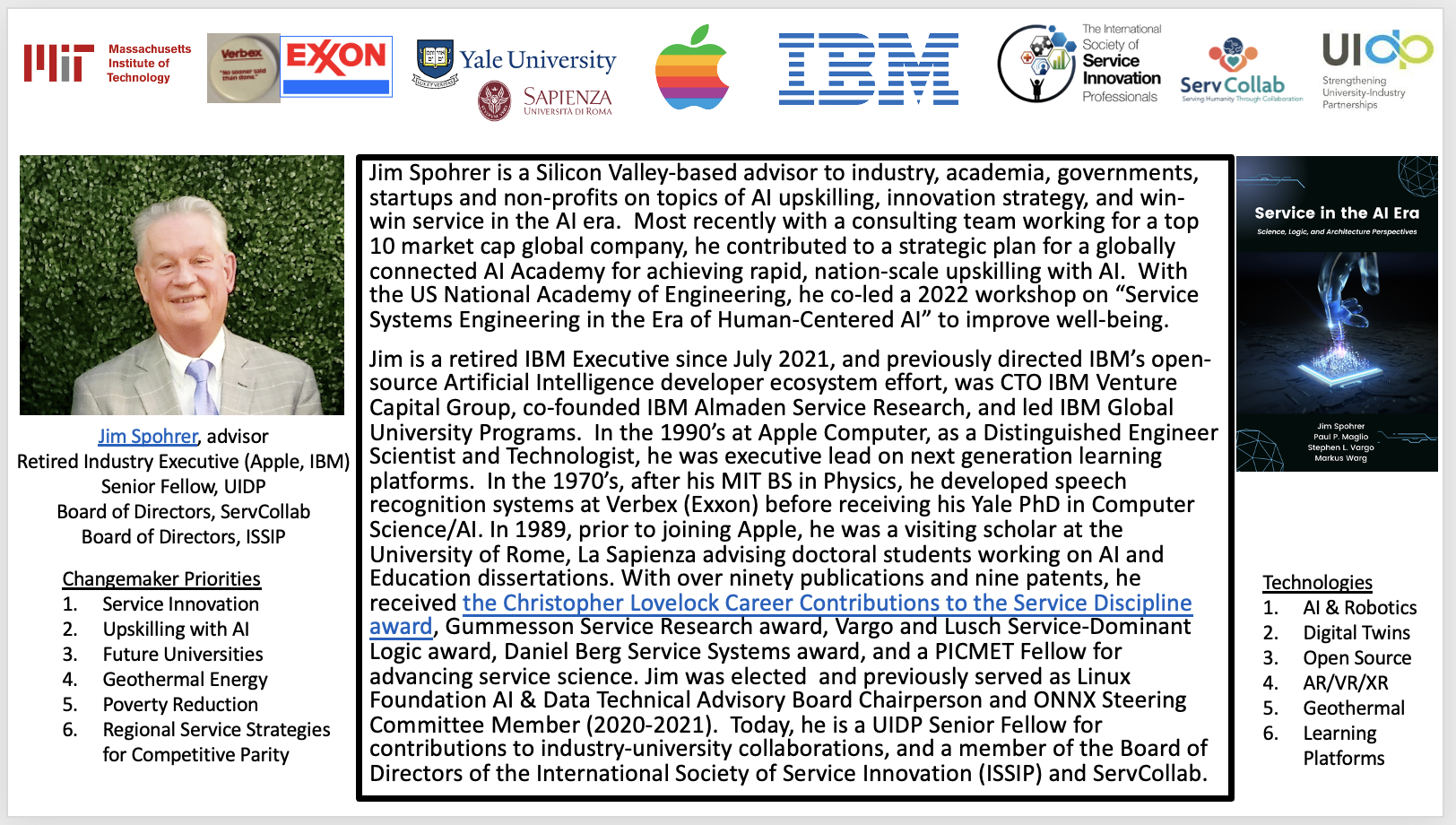
Jim Spohrer (2023)

Jim Spohrer (2023)

Picture (2022, Santa Clara, CA – ISSIP Event):

Jim Spohrer

Jim Spohrer

Picture (2008, San Jose, CA, while Director, IBM Almaden Service Research Group):

Jim Spohrer

Jim Spohrer

Picture (October 15, 2016 Chongqing China, while keynoting at 9th ICSS -International Conference on Service Science):
Jim Spohrer (Oct 2016)

Jim Spohrer (Oct 2016)

Jim Spohrer (Feb 2018) – photo by Michael Maximillien

In 2011 during IBM’s Centennial Celebration, Jim Spohrer was recognized as an IBM Innovation Champion for his contributions to service science.  Service science is one of the 100 innovations celebrated during IBM’s Centennial as an IBM Icon of Progress:  http://www.ibm.com/ibm/history/ibm100/us/en/icons/servicescience/.

Service is defined as the application of knowledge for mutual benefits, a type of value co-creation from win-win interactions.  It is the observable and measurable phenomena of responsible entities applying knowledge to achieve non-zero-sum outcomes from interactions and change.  Service is a fundamental concept that connects is surprising ways to other fundamental concepts (areas of study) where entities are part of an evolving ecology with auto-catalytic properties:  Atoms and stars (physics), molecules and planets (chemistry), organisms and niches (biology), humans and cultures (social sciences), with many other transdisciplinary  connections to nations and law (politics), businesses and risk (organization theory),  value and resources, supply and demand, comparative advantage (economics), physical symbol systems and algorithms (computer science), processes and optimization (operations research), signals and feedback loops (control theory), structure-function-and-behavior and emergence (systems), history and predictions (data science), contracts and evidence (law), entropy and communications (information theory), environment and evolution (ecology), decision-making (management), and many other areas.

The service ecology (all the people, businesses, and nations) is evolving new types of service (AKA win-win games, value co-creation work and production processes), and (eventually, est. 2045) their trust-enhancing, AI-based “digital twins” may do so as well.

How is service science different from data science (which fuels artificial intelligence)?
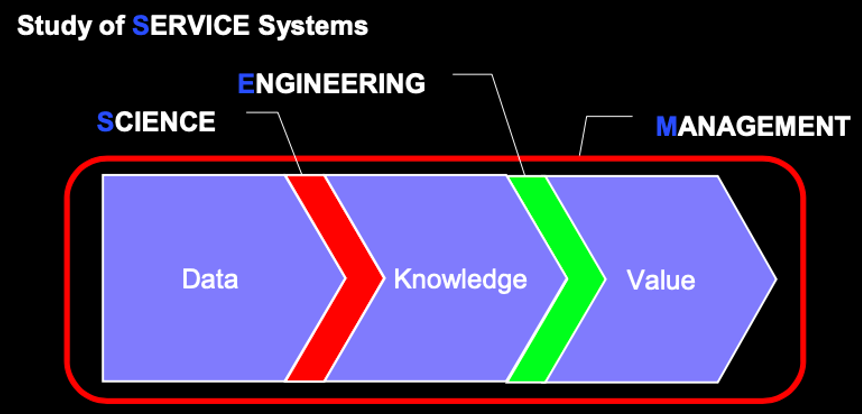
Service Science

Service science is the study of service systems (people, businesses, nations – their capabilities, constraints, rights, responsibilities, interactions, and outcomes).  Service is defined as the application of knowledge for mutual benefits (AKA value co-creation, or win-win games).  Service system entities (people, businesses, nations) are some key types of responsible entities that generate data, lots and lots of data!  Data science deals with the data that service system entities generate.  Data science is an interdisciplinary field that uses scientific methods to extract knowledge and insights from data to apply in many domains.  Service science studies the transformation and innovation of service systems, responsible entities which generate mountains of data and are constantly changing!  Service systems (people, businesses, nations) generate data about activities, interactions and outcomes. Importantly, all the many types of service systems can also be viewed as responsible entities learning to invest in change.  All responsible entities invest to become better future versions of themselves, more successful people, businesses, nations.   All responsible entities, that can learn to apply knowledge for mutual benefits (provision service), can also learn to learn to invest better in their future success, by recognizing the more valuable activities and interactions (optimization, social learning, and invention) that lead to more valuable outcomes, and thereby more resources for future resource integration and investment opportunities.  Data science can be viewed as one type of activity that is part of service science that is used for accelerated improvement of service systems across industries, finance, retail, healthcare, etc.  Learning to invest more mindfully and systematically is what responsible entities do as they coordinate their upskilling (co-elevation of capabilities) for the future.  As entities upskill (become more capable) themselves, they can innovate better and seize more opportunities to interact and  co-create value; they can invent better and better win-win games to play.  The innovation of service systems (service innovation), is not just about better technology, but about an evolving ecology of responsible entities interacting with better natural and technological infrastructure, better business models and government institutions, better trust and sharing of information, better human-centered design and skills in individuals.  Service innovations lead generally to better quality-of-life and opportunities for entities, and specifically to better non-zero-sum interactions among the entities in business and society.  Better non-zero-sum interactions has been described as the logic of human destiny.  The history of humankind provides clear lessons of upward interaction spirals (increased understanding of ourselves and others) and downward interaction spirals (increased fear of the future and others).  AI will allow us to build better “digital twins” of all entities, ourselves and others, increasing our understanding and improving our interactions and outcomes.  Service science like data science, is one of the sciences of “better.”  While service science has a focus on systems, which are responsible entities learning to invest in co-creating better future versions of themselves (service systems innovation), instead data science focuses on datasets coming from parts of service systems, and then extracting knowledge and insights that can be applied in different domains.  From a service science perspective, a key purpose for data science is to produce better AI systems which can act as digital twins for all service systems.  Complexity economics can then make use of these digital twins for all service systems to perform trillions of simulations of the evolving ecology of entities and their possible strategies.  From a service science perspective, a key purpose of complexity economics is simulate possible entity interaction strategies and thereby search for improved government institutions and public policy strategies, business model strategies, individual upskilling strategies, and improve the way responsible entities learn to invest in creating better future versions of themselves and their AI digital twins.  Service science is based on the worldview of Service-Dominant Logic.  Service science is an emerging transdiscipline that seeks to integrate better all existing disciplines into an integrated whole, requiring T-shaped skills (depth and breadth) in people, and builds on the conceptual foundation of multidisciplinary thinking, including the “accelerating socio-technical system design loop” and “techno-extension factors” that augment human intelligence, to address complex, urgent problems.

Service science is short for SSME+DAPP = Service Science Management Engineering (tool system) + Design Arts Pubic Policy (human system).

Jim Spohrer Resume 20210630

Dossier Resume Curriculum Vitae Dec 2020 at IBM

Click here for NSF format JS
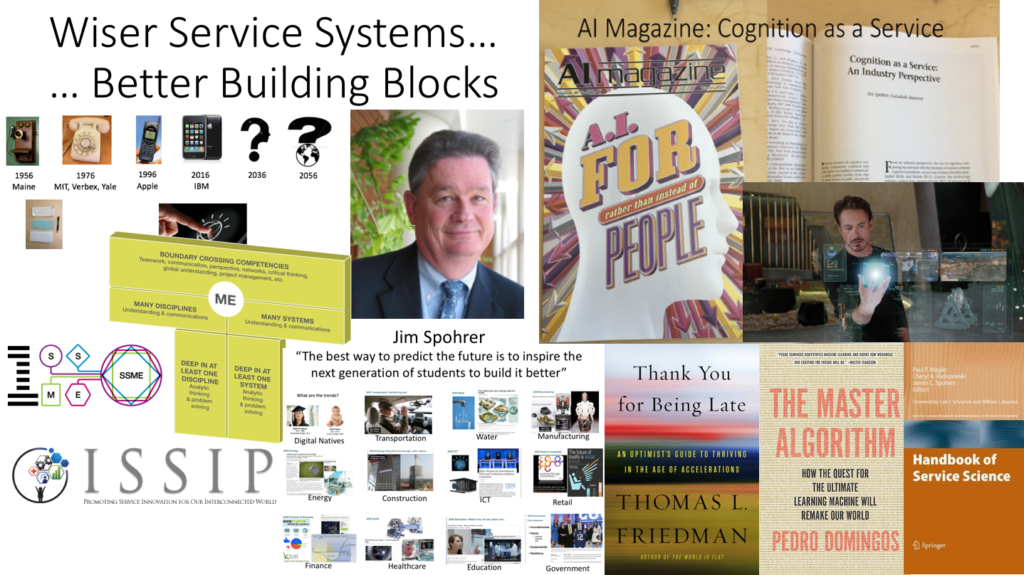
The best way to predict the future is to inspire the next generation of students to build it better

Contact:

Dr. James (“Jim”)  C. Spohrer
Innovation Champion (http://www-03.ibm.com/ibm/history/ibm100/us/en/icons/servicescience/)
ISSIP (http://www.issip.org)

Contact:

Address: ISSIP, #431, 3561 Homestead Road, Santa Clara, CA 95051-5161
spohrer@gmail.com 408-829-3112 (iPhone)
Skype: james.clinton.spohrer

Social Media Me:

LinkedIn: Jim Spohrer (http://www.linkedin.com/in/spohrer/)
Twitter: @JimSpohrer (https://twitter.com/JimSpohrer)
Bio: http://en.wikipedia.org/wiki/Jim_Spohrer
Blog: http://www.service-science.info
Slides: http://www.slideshare.net/spohrer
YouTube: https://www.youtube.com/channel/UCkFGgjwrcJyXbPoaTjeMcvw
GitHub: https://github.com/jimspohrer

Patents and Publications
http://scholar.google.com/citations?user=7T2Pz1YAAAAJ
June 2021 (h-index all =  49, meaning that 49 of my publications have been cited 49 times or more)

Conference: IAMOT 2013 in Porto Alegre, Brazil on April 14-18, 2013

The International Association for Management of Technology (IAMOT) will host its 22nd Annual conference, IAMOT 2013 in Porto Alegre, Brazil on April 14-18, 2013. This year’s conference theme is “Science, Technology and Innovation in the Emerging Market Economies.”

IAMOT 2013 is expected to attract between 400 and 500 delegates worldwide, in addition to local participants, making it the largest gathering of its kind.

In addition to the technical sessions, the IAMOT and the IAMOT2013 local committee have put together an exciting program that includes: 4 pre-conference workshops, 3 excellent keynote speakers, and 4 panel discussions of technology-related themes with prominent technology managers, economists, and policy makers.  In addition to these events, site visits to a variety of technology centers has been arranged.  Also taking place is the IAMOT 2013 award ceremony in which we acknowledge the contributions of awardees in the field of management of technology for the year.

This year’s conference is of particular importance to developing countries to understand how technology and its management changed Brazil, which in a span of few years has become one of the leading economies of the world.

More information can be found on the conference website: www.iamot2013.ea.ufrgs.br

I invite you all to submit your contribution to the conference. I am attaching the call for papers and the IAMOT 2013 informational brochure. The deadlines are:

Submission of Abstract (by or before)           October 1st 2012

Notification of Acceptance (by or before)      November 1st 2012

Submission of Full Papers                              January 4th 2013

Notification of Paper Acceptance/ Revision February 22nd 2013

Final version                                                    March 8th 2013

Thank you and looking forward to greeting you in Brazil.

Sincerely,

Dr. Yasser Hosni, PE

Co-Chair, IAMOT 2013 conference in Porto Alegre, Brazil, April 14-18, 2013

www.iamot2013.ea.ufrgs.br

IIE Fellow, Professor Emeritus

University of Central Florida

Orlando, Fl. 32816

(407) 545-6062

yhosni@ucf.edu

Call For Chapters: IT-Based Service Systems (Dec. 15th)

Call for Chapters,
Book on: “Engineering and Management of IT-based Service Systems:
An Intelligent Decision-Making Support Systems Approach”

Deadline Extended!!!

Book series:
“Intelligent Systems Reference Library”
Springer-Verlag, London Ltd
http://www.springer.com/series/8578

BOOK’S RATIONALE:

A service economy has been recognized as the dominant paradigm in present
times (Chesbrough and Spohrer 2006). Such a service-oriented worldview
demands new engineering and management scientific (both fundamental and
applied) knowledge to cope with the planning, design, building, operation
and evaluation (including the disposal of non adequate) IT-based service
systems (IfM and IBM 2008). Furthermore, several ITSM process models
and standards are available (ITIL v2, ITIL v3, ISO/IEC 20000, CMMI-SVC,
ITUP, MOF 4.0, and CobIT 5.0). Such challenges emerge from the paradigm
shift from a product-based manufacturing economy to this new
service-oriented one (Dermikan et al. 2011). In turn, Intelligent
Decision-Making Support Systems (i-DMSS/DSS) are specialized IT-based
systems that support some or several phases of the individual, team,
organizational or inter-organizational decision making process by
deploying some or several intelligent mechanisms (Forgionne et al. 2002;
Phillips-Wren et al. 2009). In particular, Artificial Intelligence (AI)
has been recognized as a significant enhancement tool for DMSS (Goul et
al. 1992; Eom, 1998) since several decades. However, the utilization of
i-DMSS/DSS for engineering and management of IT-based service systems is
still scarce. We believe that fostering its research and utilization is
relevant and needed for advancing the progress of IT-service systems.
Consequently, in this book will pursue to following academic aims: (i)
generate a compendium of quality theoretical and applied contributions in
Intelligent Decision-Making Support Systems (i-DMSS) for engineering and
management IT-based service systems (ITSS); (ii)  diffuse scarce knowledge
about foundations, architectures and effective and efficient methods and
strategies for successfully planning, designing, building, operating, and
evaluating i-DMSS for ITSS, and (iii) create an awareness of, and a bridge
between ITSS and i-DMSS academicians and practitioners in the current
complex and dynamic engineering and management ITSS organizational (Mora
et al. 2011).

References:

Chesbrough, H. and Spohrer, J. (2006). A research manifesto for services
science. Communications of the ACM. 49(7). 35–40.

Dermikan, H., Spohrer, J. and Krishn, V. (2011). Introduction of the
Science of Service Systems. In:  H. Demirkan, J. Spohrer, and V. Krishna
(Eds). The Science of Service Systems. Service Science: Research and
Innovations in the Service Economy Series, Springer, New York, 1-10.

Eom, S. (1998). An Overview of Contributions to the Decision Support
Systems Area from Artificial Intelligence.  Proceedings of the AIS
Conference (1998), Baltimore, MA, USA, August 14-16.

Forgionne, G.A., Gupta, J. N. D., Mora, M. (2002). Decision making support
systems: Achievements, challenges and opportunities: In : Mora, M.,

Forgionne, G., Gupta, J.N.D. (Eds.) :Decision making support systems:
achievements and challenges for the new decade. Idea Group, Hershey, PA,
392-403.

Goul, M., Henderson, J., Tonge, F. (1992). The Emergence of Artificial
Intelligence as a Reference Discipline for Decision Support Systems
Research. Decision Sciences, 23, 1263-1276.

IfM and IBM. (2008). Succeeding through Service Innovation: Developing a
Service Perspective for Education, Research, Business and Government.
Cambridge, UK: University of Cambridge Institute for Manufacturing.

Mora, M., O’Connor, R., Raisinghani, M., Macias-Luevano, J. & Gelman, O.
(2011).  An IT Service Engineering and Management Framework (ITS-EMF).
International Journal of Service Science, Management, Engineering and
Technology (IJSSMET), 2(2), 1-16.

Phillips-Wren, G., Mora, M., Forgionne, G., and  Gupta, J. (2009). An
Integrative Evaluation Framework  for Intelligent Decision Support
Systems. European Journal of Operational Research (EJOR), 195(3), 642-652.

TOPICS OF INTEREST:

High quality fundamental or applied research-oriented chapters are welcome
on the following key topics:

Section I.  Foundations on IT-based Service Systems

Topics: fundamental concepts, models/architectures, frameworks/schemes or
theories for planning, designing, building, operating or evaluating
IT-based service systems using i-DMSS.

Section II. Cases on Engineering and Management of IT-based Service
Systems supported by
i-DMSS

Topics: cases of innovative real or potential (proof of concept) i-DMSS
applications for supporting the planning, designing, building, operating
or evaluating of IT-based service systems in the main service domains such
as: financial, legal, healthcare, logistics, educational, and military.
AI-based technologies as such: logic rule-based systems, ontology-based
systems, machine learning techniques,  multi-agent systems techniques,
neural networks systems, fuzzy logic systems, cased-based reasoning
systems, genetic algorithms techniques, data mining algorithms,
intelligent agents, user intelligent interfaces among others are welcome.

Section III. Trends and Challenges on Engineering and Management of
IT-based Service Systems supported by i-DMSS

Topics: emergent AI-based technologies, integrations of these
technologies, and the implications, challenges and trends for supporting
the individual, team, organizational or inter-organizational
decision-making processes applied to IT-based service systems, from a
technical and organizational perspective.

IMPORTANT DATES:

Deadline extended to Dec 15th…

* September 30, 2012 – submission deadline of first version of full
chapters.
* November 15, 2013 – notification deadline of editorial results
(definitively accepted chapter, conditioned chapter, or definitively
rejected chapter).
* February 28,  2013 – submission deadline of second improved
version of conditioned chapters.
* March 31, 2013 – notification deadline of definitive editorial
decision on conditioned chapters.
* April 15, 2013 – submission deadline of camera-ready versions of
accepted chapters.
* November to December 2013 – estimated publishing period.

SUBMISSION PROCESS:

Interested authors, please send your full chapter before or on September
30, 2012, to Dr. Manuel Mora at mmora@securenym.net with copy to
dr.manuel.mora.uaa@gmail.com. Each chapter will be evaluated by at least
two academic peers on related themes in a blind mode. Conditioned chapters
will have an additional opportunity for being improved and evaluated. In
the second evaluation, a definitive editorial decision among: accepted or
rejected will be reported. All of the accepted chapters must be submitted
according to the Editorial publishing format rules timely. Instructions
for authors can be downloaded at:
http://www.springer.com/cda/content/document/cda_downloaddocument/T1-book.zip?SGWID=0-0-45-392600-0

EDITORS:

Manuel Mora, EngD, Autonomous University of Aguascalientes, Mexico
Manuel Mora <dr.manuel.mora.uaa@gmail.com>
Jorge Marx Gómez, PhD,  Oldenburg University, Germany
Leonardo Garrido, PhD, Tecnológico de Monterrey, Campus Monterrey, México
Francisco Cervantes-Pérez, PhD, CCADET, UNAM, México
=============================================================================================

Aberdeen: Excellence in Service Doesn’t Come Easy…

Excellence in service doesn’t come easy and its importance continues to rise in an ever more competitive environment as seen in Aberdeen’s recent State of Service research where nearly 80% of respondents had a service leader in place with P&L responsibility for service (as compared to only 61% at the end of 2010). As service organizations look to extend and enhance service excellence, half of all Best-in-Class organizations (50%) have prioritized field service as an area for technology investment to improve customer service, drive revenues and cut costs. Join Aberdeen and SAP for this informative webinar to learn:

  • The state of the service market
  • The need for service differentiation in the field and parts management
  • Field service workforce management trends that enable Best-in-Class performance
  • Impact of mobile tools on customer service and technician utilization

Sampling of HBR Articles Cited in the Service Science Literature

100 Harvard Business Review (HBR) articles relevant to the emerging service science literature

Three Questions:
– What are your top three favorites  from the list below?
– What, if any (HBR articles missing from this list) should be added for their practical insights to service innovation professionals?
– What publications (besides HBR) would have many articles most useful to service-innovation-practitioners in industry and entrepreneurial teams?


1. Customer Fit in Service Operations (I)
Chase, Richard B. (1978), “Where Does the Customer Fit in a Service Operation?,” Harvard Business Review, 56 (November-December), 137-42.

2. Behavioral Sciences (I)
Chase, R.B., Dasu, S., 2001. Want to perfect your company’s service? Use behavioral science. Harvard Business Review (June), 79–84.

3. Service Factory – Productivity  (III)
Chase, R.B.,Garvin, D. (1989) The Service Factory, Harvard Business Review, July-August 1989 (lead article), pp. 61-69.

4. Service Science (I, II II)
Chesbrough, H. (2005) Toward a science of services. Harvard Business Review 83, 16–17.

5. Industrialization of Service – Productivity (III)
Levitt, Ted (1976), “Industrialization of Service,” Harvard Business Review, 54 (September-October), 63-74.

6. Designing Services that Deliver – Quality (II)
Shostack, Lynn (1984), “Designing Services that Deliver,” Harvard Business Review, 62 (January-February), 133-39.

7. Putting the Service-Profit Chain to Work – Quality (II)
Heskett, James L., Thomas O. Jones, Gary W. Loveman, W. Earl Sasser, Jr., and Leonard A. Schlesinger (1994), “Putting the Service-Profit Chain to Work,” Harvard Business Review (March/April), 164-72.

8. Quality Comes To Services – Quality (I & II)
Reichheld, Frederick and W. Earl Sasser, Jr. (1990), “Zero Defections: Quality Comes to Services,” Harvard Business Review, 68 (September/October), 105-11.

9. Profitable Art of Service Recovery – Quality (I & II)
Hart, Christopher W.L., W. Earl Sasser, Jr., and James L. Heskett (1990), “The Profitable Art of Service Recovery” Harvard Business Review, (July-August), 148-56.

10. Matching Supply and Demand (Productivity)
Sasser, W. Earl (1976), “Match Supply and Demand in Service Industries,” Harvard Business Review, 54 (November-Decem- ber), 133-40.

11. The Service Driven Company (Quality)
Schlesinger, Leonard A. and James L. Heskett (1991), “The Service-Driven Service Company,” Harvard Business Review (September/October), 71-81.

12. Effective Marketing for Professional Services (Growth)
Bloom, Paul N. (1984), “Effective Marketing for Professional Services,” Harvard Business Review (September/October), 102-10.

13. Capturing Value of Supplementary Services (Growth, Scope, Adjacent Spaces, Sustainable Innovation, Quality)
Anderson, James C. and James A. Narus (1995), “Capturing the Value of Supplementary Services,” Harvard Business Review, 73 (January/February), 75-83.

14. Cost Accounting Comes to Service Industries (Productivity)
Dearden, John (1978), “Cost Accounting Comes to Service Industries,” Harvard Business Review, 56 (September-Oc- tober), 132-140.

15. Production-Line Approach to Services (Productivity)
Levitt, Theodore (1972), “Production-Line Approach to Services,” Harvard Business Review, 50 (September-Octo- ber), 42-52.

16. Knowledge Based Busienss (Sustainable Innovation)
Davis, S., J. Botkin. 1994. The coming of the knowledge-based business. Harvard Bus. Rev.72 (Sept./Oct.) 165-170.

17.Exploiting the Virtual Value Chain (Productivity)
Rayport, Jeffrey F. and John J. Sviokla (1995), “Exploiting the Virtual Value Chain,” Harvard Business Review, 73 (November/December), 14-24.

18. Surviving the Revolution
Karmarkar, Uday (2004).“Will You Survive the Services Revolution?,” Harvard Business Review, 82 (June) 100–108.

19. Value Constellations
Normann, Richard and Rafael Ramirez (1993). “From Value Chain to Value Constellation: Designing Interactive Strategy,” Harvard Business Review, (July–August) 65–77.

20. Making Mass Customization Work
Pine, Joseph B., II, Bart Victor, and Andrew C. Boynton (1993), “Making Mass Customization Work,” Harvard Business Re- view, 71 (September/October), 108-19.

21. Service Life Cycle of Products
Potts, G.W. (1988), ªExploiting your product’s service life cycleº, Harvard Business Review, Vol. 66 No. 5, pp. 32-5.

22. Beyond Products: Services-Based Strategy
Quinn, J.B., Doorley, T.L. and Paquette, P.C. (1990), “Beyond products: services-based strategy,” Harvard Business Review, Vol. 68 No. 2, pp. 58-67.

23. Unconditional Service Guarantees
C.W.L. Hart, “The Power of Unconditional Service Guarantees,” Harvard Business Review, 66(4) July-August 1988, 54-62

24. Governance
Mintzberg, Henry. 1996. Managing Government, Governing Management. Harvard Business Review74(3): 75-83.

25. IT
McAfee A, Brynjolfsson E. 2008. Investing in the IT that makes a competitive difference. Harvard Business Review 86(7–8).

26. Sell Services More Profitably
Reinartz, W. and Ulaga, W. (2008) How to Sell Services More Profitably, Harvard Business Review, 86: 90-96.

27. Downstream profits
Wise, R. and Baumgartner, P. (1999) Go Downstream: The New Profit Imperative in Manufacturing. Harvard Business Review, Sept-Oct, 133-141.

28. House of Quality
Hauser, John R. and Don Clausing (1988), “The House of Quality,” Harvard Business Review, 66 (May-June), 63-73.

29. Experience Economy
Pine, B. Joseph and James H. Gilmore (1998), Welcome to the Experience Economy.Harvard Business Review.

30. Core Competence of the Corporation
Prahalad, C.K. and Gary Hamel (1990), “The Core Competence of the Corporation,” Harvard Business Review, 68 (May-June), 79-91.

31. Co-opting Customer Competence
Prahalad, C.K and Venkatram Ramaswamy (2000), “Co-opting Customer Competence,” Harvard Business Review, 78 (January- February), 79-87.

32. Strategy and the New Economics of Information
Evans, Philip B. and Thomas S. Wurster (1997), “Strategy and the New Economics of Information,” Harvard Business Review, 75 (September-October), 71-82.

33. Symbols for Sale
Levy, Sidney J. (1959), “Symbols for Sale,” Harvard Business Review, 37 (July–August), 117–24.

34. How Brands Become Icons
Holt, Douglas B. (2004), How Brands Become Icons: The Principles of Cultural Branding, Cambridge, MA: Harvard Business School Press.

35. Reengineering works
Hammer, M. (1990). ‘Reengineering works: Don’t automate, obliterate’, Harvard Business Review, 68(4), pp. 104–112.

36. Lean Service Machine
Swank CK. The lean service machine. Harvard Bus Review 2003; 81(10):123-129, 38.

37. Fixing Health Care
Spear SJ. Fixing health care from the inside, today. Harvard Bus Review 2005;83(9):78-91.

38. Competing for the Future
Hamel, G., & Prahalad, C. K. 1994. Competing for the future. Boston, MA: Harvard Business School Press.

39.Balanced Scoreboard
Kaplan, R.S., & Norton, D. P. 1992. The balanced scorecard: Measures that drive performance. Harvard Business Review, 70(1): 71-79.

40. Competing on capabilities
Stalk, G., Evans, P., & Shulman, L. 1992. Competing on capabilities: The new rules of corporate strategy. Harvard Business Review, 70(2): 57-69.

41. Lessons in the Service Sector
Heskett, James L. (1987), “Lessons in the Service Sector,” Harvard Business Review, 87 (March-April), 118-26.

42. Value Innovation
Kim, W. C. & Mauborgne, R. (1997). Value innovation: The strategic logic of high growth. Harvard Business Review, 75(1), 103-112.

43. Creating new market space
Kim, W. C. & Mauborgne, R. (1999). Creating new market space. Harvard Business Review, 77(1), 83-93.

44. Learning to love the service economy
Canton, I. D. [1984] ‘Learning to love the service economy’, Harvard Business Review, may-June, 89-97.

45. Hearing the voice of the market
Barabba, Vincent and Gerald Zaltman (1991), Hearing the Voice of the Market. Cambridge, MA: Harvard Business School Press.

46. Information and Competitive Advantage
Porter, Michael E. and Victor E. Millar (1985), “How Information Gives You Competitive Advantage,” Harvard Busi- ness Review, 85 (July-August), 149-60.

47. Relationship marketing
Fournier, Susan Susan Dobscha, and David Glen Mick (1998), “Preventing the Premature Death of Relationship Marketing,” Harvard Business Review, 77 (January/February), 42-51

48. Desgin
Leonard, Dorothy and Jeffrey F. Rayport (1997), “Spark Innovation through Empathic Design,” Harvard Business Review, 75 (November/December), 102-13.

49. Trust and virtual organization
Handy, C. (1995). Trust and the virtual organization. Harvard Business Review, 73(3), 40-48.

50. Contextual marketing & Internet
Kenny, D., & Marshall, J. F. (2000). Contextual marketing: The real business of the Internet. Harvard Business Review, 78(6), 119-125.

51. Commoditization of Process
Davenport, T. The coming commoditization of processes. Harvard Business Rev. (June 2005), 100–108.

52. Manager Job
Mintzberg, H. The manager’s job: Folklore and fact. Harvard Business Review (July/Aug. 1975), 49–61.

53. Knowledge Creating Company
Nonaka, I. The knowledge creating company. Harvard Business Review 69 (Nov–Dec 1991), 96–104.

54. Business Models Matter
Magretta, J. (2002), “Why business models matter”, Harvard Business Review, Vol. 80 No. 5, pp. 86-92.

55. Business Model
Johnson M. W., Christensen, C. M. and Kagermann, H. (2008), “Reinventing your business model”, Harvard Business Review, Vol. 86 No. 12, pp. 50-59.

56. Value Proposition
Anderson, J. C., Narus, J. A., & van Rossum, W. (2006). Customer value propositions in business markets. Harvard Business Review, 84, 90–99.

57. Increasing Return
Arthur, W. B. “Increasing Returns and the New World Of Business,” Harvard Business Review (74:4), July-August 1996, pp. 100-109.

58. Restitching
Eisenhardt, K., and Brown, S. L. “Patching: Restitching Business Portfolios in Dynamic Markets,” Harvard Business Review (77:3), May/June 1999, pp. 72-82.

59. Coevolving
Eisenhardt, K., and Galunic, D. C. “Coevolving: At Last, a Way to Make Synergies Work,” Harvard Business Review (78:1); January/ February, 2000, pp. 91-102.

60. Strategy as Simple Rules
Eisenhardt, K., and Sull, D. “Strategy as Simple Rules,” Harvard Business Review (79:1), 2001, pp. 107-116.

61. Strategy and the Internet
Porter, M. (2001) “Strategy and the Internet,” Harvard Business Review, March-April 2001, pp. 63-78.

62. Value Disciplines
Treacy, M., and Wiersema, F. “Customer Intimacy and Other Value Disciplines,” Harvard Business Review (71:1), January/February 1993, pp. 84-93.

63. Games and Strategy
Brandenburger, A. M., & Nalebuff, B. J. 1995. The right game: Use game theory to shape strategy. Harvard Business Review, 73(4): 57-71.

64. Organizational change
Greiner, L.1972. Evolution and revolution as organizations grow. Harvard Business Review, 50(4): 37-46

65. Competitor collaboration
Hamel, G., Doz, Y. L., & Prahalad, C. K. 1989. Collaborate with your competitors-and win. Harvard Business Review, 67(1): 133-140.

66. Beyond Vertical Integration
Johnston, R., & Lawrence, P. R. 1988. Beyond vertical integration: The rise of the value-adding partnerships. Harvard Business Review, 88(4): 94-101.

67. Collaborative Advantage
Kanter, R. M.1994. Collaborative advantage. Harvard Business Review, 72(4): 96-108.

68. Global Logic
Ohmae, K.1989. The global logic of strategic alliances. Harvard Business Review, 67(2): 143-154.

69.  Cooperate to Compete
Perlmutter, H. V., & Heenan, D. A. 1986. Cooperate to compete. Harvard Business Review, 86(2): 136-152.

70. Planning as Learning
DeGeus, Arie P. (1988), “Planning as Learning,” Harvard Business Review, 66 (March/April), 70-74.

71. Competing on the Eight Dimensions of Quality
Garvin, David A. (1987), “Competing on the Eight Dimensions of Quality,” Harvard Business Review, 57, 173-84.

72. Customer-Centered Brand Management
Rust, R. T., V. A. Zeithaml, K. N. Lemon. 2004. Customer-centered brand management. Harvard Bus. Rev. 82(9) 110-118.

73. Humble Decision Making
Etzioni Amitai (1989), “Humble Decision Making,” Harvard Business Review, 67 (July-August), 122-26.

74. Cultural Issues
Nonaka, Ikujiro (2007) The Knowledge-Creating Company. HBR.
M. Baba and J. Gluesing (1992), Knowledge creation:  Japan vs. the West, HBR 70(1):157-58.

75. Supply Chain
Bowersox, Donald J.  1990.  The Strategic Benefits of Logistics Alliances.  HBR 90(4):4-11.

76.  Service Worker Productivity
Drucker, Peter F.  1991.  The New Productivity Challenge.  HBR 91, November/December, 70-79.

77. Service Analytics
Davenport, T., Mule, L. D., & Lucker, J. (2011), Know what your customers want before they do. Harvard Business Review, 89, 84-92.

78. Service Excellence
Frei, F. X. 2008. The four things a service business must get right. Harvard Business Review 86(4): 70–
80.

79.  Value-cocreation
Ramaswamy, V., Gouillart, F., 2010, Building the cocreative enterprise, Harvard Business Review, Volume 88 (10): 100-109.

80. Customer Experience
Meyer, Christopher and Andre Schwager (2007), “Understanding Customer Experience,” Harvard Business Review, February 117–26.

81. Customer-Employee Interactions
Fleming, J. H., Coffman, C., & Harter, J. K. (2005). Manage your human sigma. Harvard Business Review, 83(7/8), 106–114.

82. Strategy
Marco Iansiti and Roy Levien. Strategy as Ecology. Harvard Business Review, 82(3):68–78, March 2004a.

83. Self-Service
Moon, Y. and Frei, F.X. (2000), “Exploding the self-service myth’’, Harvard Business Review, Vol. 78 No. 3, pp. 26-7.

84. Customers
Dougherty D, Marty A (2008). What service customers really want? Harvard Business Review, September: p. 22.

85. Customer loyalty
O’Brien, Louise and Charles Jones, “Do Rewards Really Create Loyalty?”, Harvard Business Review (May – June, 1995), 75–82.

86. Strategy
Allmendinger, G.; Lombreglia, R.; Four Strategies for the Age of Smart Services. Harvard Business Review, Oct2005, Vol. 83 Issue 10, pp.131-145.

87. Customer Satisfaction
Taylor, A. (2002, July). Driving customer satisfaction. Harvard Business Review, 24-25.

88. Quality and Productivity Tradeoff
Frei, Frances X. (2006), “Breaking the trade-off between efficiency and service,” Harvard Business Review, 84 (11), 92-101.

89. Service Innovation
Thomke, Stefan (2003), “R&D Comes to Services,” Harvard Business Review, 81 (4), 70-79.

90. Contracting
Marcus, Sumner (1964), “Studies of Defense Contracting,” Harvard Business Review, 42 (3), 20-184.

91. Employees and Customers
Chun, Rosa, and Gary Davies. “Employee Happiness Isn’t Enough to Satisfy Customers.” Harvard Business Review 87.4 (2009): 19.

92. Service Quality and Customer Trust
Bell, Simon J. and Andreas B. Eisingerich (2007), ―Work With Me,‖ Harvard Business Review, 85 (March), 32.

93. Productivity
Merrifield, R., Calhoun, J., & Stevens, D. (2008). The next revolution in productivity. Harvard Business Review, June, 72–80.

94. Global Networks
Bartlett, C., & Ghoshal, S. 1989. Managing across borders: The transnational solution. Boston, MA: Harvard Business School Press.

95. Global Networks & Developing Economies
Khanna, T., & Palepu, K. 2006. Emerging giants: Building worldclass companies in developing countries. Harvard Business Review, 84(10): 60–69.

96. Offshoring
Farrell, D. 2006. “Smarter Offshoring,” Harvard Business Review (84:6), pp. 85-92.

97.  Innovation
Deborah Wince-Smith (2005) “Innovate at your own risk”, Harvard Business Review, Vol. 83 No.5, pp.25.

98. Strategy
Dawar N, Frost T. 1999. Competing with giants: survival strategies for local companies in emerging markets. Harvard Business Review 77(2): 119–129.

99. Emerging Markets
Prahalad, C. K. and A. Hammond: 2002, ‘Serving the World’s Poor, Profitably’, Harvard Business Review 80(9), 48–58.

100. Not-for-profit service
Harvey, P. D., and Snyder, J. D. (1987) Charities need a bottom line too. Harvard Business Review (January-February). Harvard Business Publishing, Boston.


ITSqc: eSourcing Capability Model Courses

eSCM-CL Model Course
http://www.itsqc.org/training/courses/escm-cl.html

The eSourcing Capability Model for Client Organizations (eSCM-CL) Course will be taught by the ITSqc Directors, in Pittsburgh PA USA, September 12 – 14.  The course description is here.  Registration information is here.
The eSourcing Capability Model for Service Providers (eSCM-SP) Course will be taught by the ITSqc Directors, in Pittsburgh PA USA, September 19 – 21.  The course description is here.  Registration information is here.
Please feel free to contact me if you have any questions.  Note that there is an IAOP member discount for these courses.
Keep in Touch
Join the LinkedIn groups for eSCM-SP or eSCM-CL.  Visit the ITSqc home page for the latest announcements.  The ITSqc training page always lists the upcoming public training offered by ITSqc and our Authorized Training Organizations.
Best Regards,
Jeff Perdue
Director
ITSqc, LLC
ITSqc Price
US $2500.00

Course Description
The eSourcing Capability Model for Client Organizations (eSCM-CL) is a “best practices” capability model with two purposes: (1) to give client organizations guidance that will help them improve their capability across the sourcing life-cycle, and (2) to provide client organizations with an objective means of evaluating their sourcing capability.

The eSourcing Capability Model for Client Organizations course introduces participants to the concepts, terminology, and structure of the Model and the interrelationships of the Model components. Participants will gain an understanding of the value of the Model for clients and service providers, learn about the eSCM-CL’s practices for sourcing, identify major characteristics of client organizations at different capability levels, gain an introductory understanding of how the Capability Determination Process is carried out, and be given ideas for introducing eSCM-CL in their organizations. Participants who have successfully completed the course will receive a certificate of completion.

Materials
As part of the course, participants will receive the Model, “eSourcing Capability Model for Client Organizations,” the course notebook and supplemental readings.
Topics

  • What is IT-enabled Sourcing?
  • Benefits and Risks
  • Success and Failures in Sourcing
  • Need for and Development of the Model
  • Model Structure
  • Practice Descriptions
  • Support Practices
  • Capability Areas
  • Capability Levels
  • Using the Model
  • The Capability Determination Process
  • Introducing the eSCM-CL into Organizations
Objectives
There are eight overall learning objectives for this course:

  • Be able to define IT-enabled sourcing and the reasons for success or failure
  • Be able to describe the value of the Model to client organizations and service providers.
  • Understand the structure of the eSCM-CL and the interrelationship of its components.
  • Become familiar with practices in each Capability Area.
  • Learn about the characteristics for each of the 5 Capability Levels.
  • Understand how the Model can be used by clients, service providers, and quality consultants.
  • Gain a high level understanding of the eSCM Capability Determination Process.
  • Develop an initial concept of how to introduce the eSCM-CL into your organization.
Schedule
9 a.m. to 5 p.m. each day.


eSCM-SP and eSCM-CL Model Courses Available
The eSourcing Capability Model for Client Organizations (eSCM-CL) Course will be taught by the ITSqc Directors, in Pittsburgh PA USA, September 12 – 14.  The course description is here.  Registration information is here.
The eSourcing Capability Model for Service Providers (eSCM-SP) Course will be taught by the ITSqc Directors, in Pittsburgh PA USA, September 19 – 21.  The course description is here.  Registration information is here.
Please feel free to contact me if you have any questions.  Note that there is an IAOP member discount for these courses.
Keep in Touch
Join the LinkedIn groups for eSCM-SP or eSCM-CL.  Visit the ITSqc home page for the latest announcements.  The ITSqc training page always lists the upcoming public training offered by ITSqc and our Authorized Training Organizations.
Best Regards,
Jeff Perdue
Director
ITSqc, LLC

CFP: Conference on Resource Intensive Applications and Services (Lisbon, March 2013)

The submission deadline is October 29, 2012.

Authors of selected papers will be invited to submit extended article versions to one of the IARIA Journals: http://www.iariajournals.org

=================

============== INTENSIVE 2013 | Call for Papers ===============

CALL FOR PAPERS, TUTORIALS, PANELS

INTENSIVE 2013, The Fifth International Conference on Resource Intensive Applications and Services

March 24 – 29, 2013 – Lisbon, Portugal

General page: http://www.iaria.org/conferences2013/INTENSIVE13.html

Call for Papers: http://www.iaria.org/conferences2013/CfPINTENSIVE13.html

– regular papers

– short papers (work in progress)

– posters

Submission page: http://www.iaria.org/conferences2013/SubmitINTENSIVE13.html

Submission deadline: October 29, 2012

Sponsored by IARIA, www.iaria.org

Extended versions of selected papers will be published in IARIA Journals:  http://www.iariajournals.org

Print proceedings will be available via Curran Associates, Inc.: http://www.proceedings.com/9769.html

Articles will be archived in the free access ThinkMind Digital Library: http://www.thinkmind.org

Please note the Poster and Work in Progress options.

The topics suggested by the conference can be discussed in term of concepts, state of the art, research, standards, implementations, running experiments, applications, and industrial case studies. Authors are invited to submit complete unpublished papers, which are not under review in any other conference or journal in the following, but not limited to, topic areas.

All tracks are open to both research and industry contributions, in terms of Regular papers, Posters, Work in progress, Technical/marketing/business presentations, Demos, Tutorials, and Panels.

Before submission, please check and conform with the Editorial rules: http://www.iaria.org/editorialrules.html

INTENSIVE 2013 Topics (topics and submission details: see CfP on the site)

Basics on RIAS (Resource Intensive Applications and Services)

Fundamentals on RIAS; Heuristics for relaxing RIAS; Optimization on RIAS; Coordinated checkpointing and rollback in RIAS; Approximation approach in RIAS; Suboptimal solutions in RIAS; Distribution RIAS; Pervasive parallelism RIAS

Basic algorithms for RIAS

Fundamental algorithms for massive data; Specialized algorithms for grapics, statistics, bio-databases; Load-balancing and cache algoritms; Hierarchical algorithms; Streaming algorithms; Sublinear algorithms; Quick convergence algorithms; Algorithms for synchronization intensive processes; Algorithms for very high speed sustainability;

Communications intensive

Transaction RIAS; Bandwidth RIAS; Traffic RIAS; Broadcast and multicast RIAS; Propagation RIAS; Stream media intensive

Process intensive

Resource RIAS; Computation RIAS; Memory RIAS; Data acquisition RIAS; Data compression RIAS; Replication intensive RIAS; Storage RIAS; Access RIAS; Image processing RIAS

Data-intensive computing

Computing platforms; Collaborative sharing and datasets analysis; Large data streams; Data-processing pipelines; Data warehouses; Data centers; Data-driven society and economy

Operational intensive

Cryptography RIAS; Intrusion prevention RIAS; Deep packet inspection RIAS; Reconfiguration RIAS; Load-balancing RIAS; Buffering & cashing RIAS; Performance RIAS

Cloud-computing intensiveness

Infrastructure-as-a-service; Software-as-a-service [SaaS applicaitions]; Platform-as-service; On-demand computing models; Cloud computing programming and application development; Cloud SLAs, scalability, privacy, security, ownership and reliability issues; Power-efficiency and Cloud computing; Load balancing; Business models and pricing policies; Custom platforms, on-premise, private clouds; Managing applications in the clouds; Content and service distribution in Cloud computing infrastructures; Migration of Legacy Applications

User intensive

User interaction RIAS; Multi-user RIAS; User-adaptation RIAS

Technology intensive

Mobility RIAS; High-speed RIAS; Intensive real-time decoding

Control intensive

Message RIAS; Monitoring RIAS; Power consumption RIAS; Hardware for RIAS; Software for RIAS; Middleware for RIAS; Threat containment RIAS

Complex RIAS

Bioinformatics computation; Large scale ehealth systems; Pharmaceutical/drug computation; Weather forecast computation; Earthquake simulations; Geo-spatial simulations; Spatial programs; Real-time manufacturing systems; Transportation systems; Avionic systems; Economic/financial systems; Electric-power systems

Committee: http://www.iaria.org/conferences2013/ComINTENSIVE13.html

================================================